
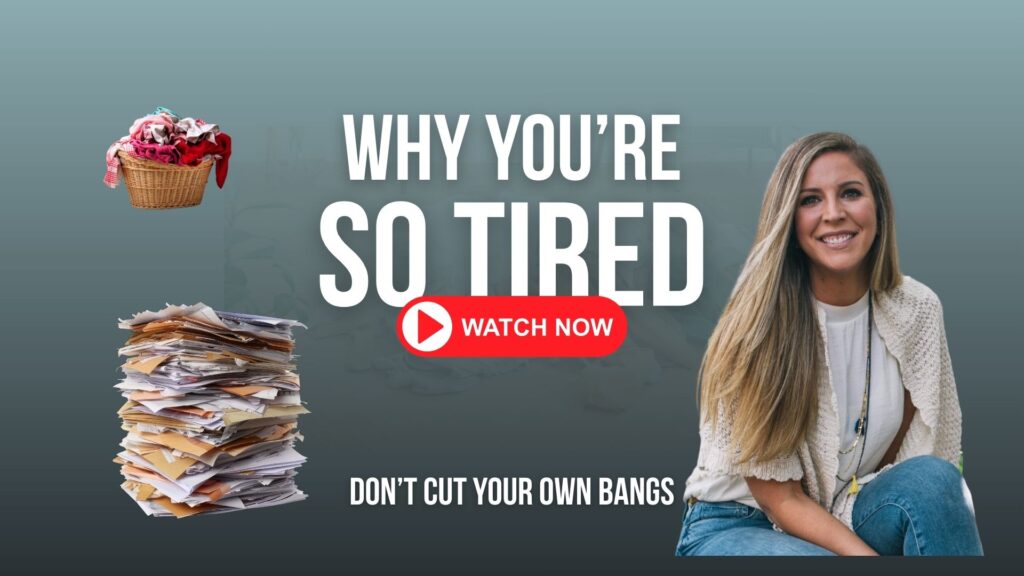
Relationship problems can feel so loud—like that’s the issue—when the quieter truth is this: you’re exhausted. And when you’re running on fumes, everything feels harder: communication, patience, decision-making, even asking for help. In this “Best Lessons of the Year” mashup episode of Don’t Cut Your Own Bangs, I pulled together two powerful clips: one on the invisible mental load and one on Support Languages—a simple framework (created by Jordan Arogeti and the team at Support Now) that helps you understand how people give support, how to “read the room,” and how to repair when you didn’t get it right the first time.
And yes—this is also about how to set boundaries, because you can’t nurture relationships if you’re silently carrying everything.
Relationship Problems and the Invisible Mental Load
The invisible mental load is that constant background hum: remembering, planning, anticipating, worrying, tracking, managing… all the things that never make it onto your calendar but somehow live in your brain rent-free.
And here’s the tricky part: the load doesn’t always look dramatic from the outside. You might be “doing fine” and still feel wrung out. That’s why relationship problems often intensify here—because you’re not just reacting to the moment, you’re reacting from depletion.
One tiny tool I love: the one-minute pause.
It sounds almost laughably simple, but a present, intentional minute changes your nervous system more than you’d think. It’s short enough for an anxious brain to tolerate, but long enough to reconnect you to your body—where your truth actually lives.
Your body says “no” before your mouth does
One of the most practical questions from this episode is:
- “Where does my body say no before my mouth does?”
Because your body gives cues first: tight chest, twisting stomach, heat, heaviness, tension. Those cues are data. And that data can help you make a boundary before you hit the breaking point.
How to Set Boundaries When You’re Carrying Too Much
A boundary doesn’t have to be a dramatic speech. Sometimes it’s simply naming the truth earlier.
Try these phrases and see how the feel to you:
- “I don’t have the capacity for this today—can we problem-solve together?”
- “I can do one part, not all of it.”
- “I need you to fully own this task.”
- “I want support, not advice right now.”
Notice how setting boundaries isn’t about controlling someone else—it’s about honoring your limits so resentment doesn’t start writing the storyline in your relationship.
Relationship Problems Improve When Support Gets Specific
This is where Jordan Arogeti’s work is so helpful. In our clip, she breaks down Support Languages—a framework designed to help people understand how they naturally give support (and how to contribute meaningfully even when they don’t know what to do). You can explore Support Now here: SupportNow supportnow.org and take the Support Languages assessment here: Support Languages supportlanguages.com.
What I love most is the reminder that support isn’t binary (all-in or nothing). Small support counts. A text counts. A meal counts. Showing up imperfectly counts.
Repair, repair, repair
Jordan says it plainly: there’s no expiration date on repair. If you didn’t show up well in the past, you can still circle back with honesty. Repair strengthens relationships because it says: I care more about you than my pride.
Links mentioned (full episodes from the clips)
- Full episode (Invisible Mental Load clip): https://youtu.be/MFQhhSd1tdk
- Full episode (Support Languages clip): https://youtu.be/qaWGCw1RE9E
A warm nudge before you go
If you’re dealing with relationship problems, please hear me: you’re not “too sensitive.” You’re not “bad at life.” You’re likely carrying too much—and your system is asking for support.
Key takeaways (save-worthy):
- Relationship problems often worsen when the invisible mental load is high—and your body is your early warning system.
- How to set boundaries can be simple, specific, and compassionate (no dramatic monologue required).
- Support Languages help you ask for what you need—and help others show up with more confidence. supportlanguages.com+1
- Repair is powerful: it’s never too late to come back and say, “I care, and I want to do better.”
RATE, REVIEW, SUBSCRIBE TO “DON’T CUT YOUR OWN BANGS”
Like your favorite recipe or song, the best things in life are shared. When you rate, review, and subscribe to this podcast, your engagement helps me connect with other listeners just like you. Plus, subscriptions just make life easier for everybody. It’s one less thing for you to think about and you can easily keep up to date on everything that’s new. So, please rate, review, and subscribe today.
DANIELLE IRELAND, LCSW
I greatly appreciate your support and engagement as part of the Don’t Cut Your Own Bangs community. Feel free to reach out with questions, comments, or anything you’d like to share. You can connect with me at any of the links below.
CONNECT WITH DANIELLE
- Follow me on: Instagram
- Check out: The Treasured Journal
- Buy my children’s book: Wrestling a Walrus
- Download: Free Essential Meditations audio series