Plating Good Seeds
[00:00:00]
[00:00:00] Hello. Hello, this is Danielle Ireland and you are catching an episode of Don’t Cut Your Own Bang, the podcast community where we help you understand and take a better look at. Do I really want banks or do I just need to talk about my feelings? We’ve got you covered. The world is noisy. It’s loud. It’s full of news, entertainment, distraction.
[00:00:20] Consumption. We’re gonna be sold things we’re gonna be told we need to buy things that there’s so much more to do. And. Sometimes we need a place, a cozy corner where we can sit down, we can curl up together and just hash it out.
[00:00:39] My intention with this base is to create a conversation and an opportunity for us all to breathe a little deeper, to share with each other and to laugh along the way. My work by day is a therapist, so I listen to and counsel people through their big feelings or their hard experiences, and I love that work.
[00:01:01] That work has. Made my life better in ways . And what it has also shown me in a way that I wish everyone could experience is that behind closed doors and the privacy of our own minds when we are really wrestling with our private thoughts, fears, insecurities, traumas, pains.
[00:01:22] The stories are unique. Yes, they’re as unique as a thumbprint. But the internal emotional experience, what drives us, what we fear, what we want, what we hope for, what we dream about, they sound so similar in that we are so much more alike than different. And. We don’t need to feel like we are the only ones shouldering the burden or racking our brains to find the answer to a question, because odds are there is somebody right next to you dealing with the exact same thing, wanting to know the exact same answer to a question.
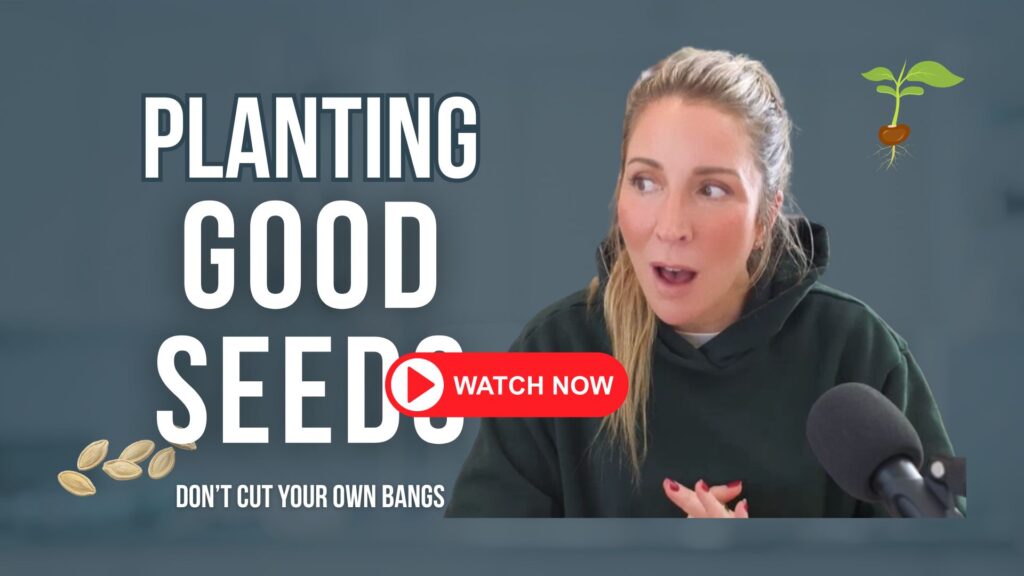
[00:01:56] And so this is a podcast container where we’re gonna dive into that together And today what I want us to focus on is. Planting good seeds. It is the beginning of 2026. It’s not quite the first of the new year, but honestly it still takes me about a full month. It takes almost the whole month of January for me to remember to write down the actual year correctly and not write down the year before.
[00:02:25] And what I’m really wanting to bring into this year is more intentionality. That’s driven by how I wanna feel, which will always make the result feel better, and the process of making it feel better as opposed to attaching to a goal and fixating on how I’m going to execute that goal. That usually leads to anxiety, burnout, and doesn’t leave room for flexibility and adaptability.
[00:02:48] But I want to create intention, more intentionality in the year I want to feel more alive and in charge and charged up in a positive and energetic way and I wanna invite you to come along with me because in the conversations I’ve been having with clients and loved ones, even with my husband yesterday in the kitchen.
[00:03:11] It’s like we’re all kind of stumbling through and feeling like we’re catching up and we don’t have to feel that way. Because if we actually think about what.
[00:03:21] This season is, and I don’t know where you’re listening in the world. I happen to be living in a place in the world where right now, January, it’s a colder month. So if we were thinking in terms of nature and communing with nature and how plants and plant, like all, all, all of life right now is a little.
[00:03:39] Dormant in my corner of the world. If I were to plant a seed, I’m not going to be able to expect a yield, a sprout, something to come from that. That doesn’t mean that the seed isn’t active, that there isn’t still some magic and some energy alive in that seed. But planting the seed means that I need to plant it and then.
[00:04:01] Leave it alone, give it some space and grace and the container that it needs to thrive and we deserve that too. So this is not about resolutions. This isn’t about attacking your year. This isn’t about setting a rigid goal that cannot change because if you change your mind, you’re not gonna follow through.
[00:04:22] I, there’s a lot I’ll say not aggressive, but very intense chatter. In the world and, I feel like January it’s just been branded poorly. It’s like the PR is just way off for what January I think really should be, or how it is for a lot of people. Um, we are all kind of recovering collectively from an emotional hangover or an actual hangover depending on how you celebrated.
[00:04:46] But this is a time where we can. Set some intentions. We can start to daydream a little more about what we want to bring and invite into this year, what we’re ready to say goodbye to from last year. What did we learn from last year? And so that’s all we’re gonna talk about today. And hopefully we’re gonna make it feel less tense, a little bit more relaxing.
[00:05:10] Help us all take a deeper, more nervous system, soothing breath, and help us start this year off on the right foot. And my interpretation of the right foot is whatever feels right to you because you are the expert in you. Nobody knows you better than you. No one knows your goals, your hopes, your dreams, or your experience is better than you.
[00:05:32] So any expert advice, and I’m using air quotes here for anybody who’s not watching this expert advice, is just that. Somebody has an area of expertise. They’ve spent a lot of time researching, studying, or practicing this thing that they’re talking about, and so they’re an expert in that one thing, but that does not make them an expert in you.
[00:05:51]
[00:05:51]
[00:06:47] I wanna go back to the seed metaphor in planting good seeds. Last year, my daughter’s class, they learned about the life cycle from a seed to a plant and what that means.
[00:06:58] And I’ll just say this, I don’t retain all the science of it, but what I know is there is a lot happening when that seed is. Beneath the soil actively happening within that seed. Long before we are able to see above the surface what that plant will become.
[00:07:18] And even in its infancy, in those early stages when there’s a sprout coming from the ground, we can see that it’s a spark of life, but we don’t really yet know. What that plant will be and like us. Like any experience in our life, anything that is existing currently started off as an idea.
[00:07:40] Somebody imagined it before it existed. Before it was a table, before it was a rocket ship, before it was a candle, somebody had a spark of an idea and that spark of an idea. Didn’t exist or it didn’t exist in that expression. It didn’t exist in that same way. It was just a seed in the ground that needed a little bit of time and space.
[00:08:02] And so if you were to give yourself that time and that space, knowing that that might look like you doing nothing that might look like you sleeping in, that might look like you taking a nap. That might look like you not. Executing every single goal or expectation that you have set for this next week?
[00:08:27] Two or three.
[00:08:28] I wanna share a quote with you from Trisha Herse, and just a little context of who Trisha Herse is. She’s founded the NAP Ministry, and she’s also written a book called Rest is Resistance, and I would highly, highly encourage everybody listening to go over to Instagram or whatever social media platform you’re most engaged with, and look up Trisha Herse and the NAP Ministry
[00:08:52] her area of expertise is grounded in capitalism, white supremacy, and spirituality. She is a force of nature, but what, when you think of a force of nature, what you think is someone who is pushing really hard, who’s who’s building with a lot of force, and what makes her work so compelling in my opinion, is that.
[00:09:16] It is the antithesis of that. What she’s learned through her studies and her experience is that softening rest is resistance. And it’s grounded in this fundamental principle that our bodies are not machines. Our bodies are not computers, they’re not pieces of equipment
[00:09:37] living entities that deserve to be honored. And when you think of yourself, not just your mental self, but all of the parts of you, when you think of yourself as divine, and I’m not even thinking in a religious context, but just simply, being and existing in this moment in time, the gift of that, the gift that you are.
[00:10:02] Are you treating yourself, treating your schedule, treating your day, treating your life with that level of profound appreciation? Because my guess is, and I’m speaking from experience here, my guess is that when you are hard on yourself. When you’re shaming yourself, when you’re being self-critical, when you’re feeling like you’re not doing enough, being enough or simply aren’t enough, it’s because you’re trying to live to a standard that is an external standard that didn’t come from you, but it’s rooted in a system that is broken and is by extension, breaking many people.
[00:10:39] I work with so many men and women. Who are deep in burnout, profoundly in burnout, and feeling like essentially I’m, I’m doing life the way that I thought I was supposed to, but I’m not feeling the way I thought I would feel. But let me offer you this quote. ‘ cause again, whether it’s a seed metaphor and letting your seed do all of its invisible magic under the surface of the soil, or this quote, however.
[00:11:07] You buy in. I want you to really just pause whatever you’re doing, if you’re doing something else while you’re listening, and take in this quote because it’s great. Rest is a generative space. There is information for your healing. In the dream space, our liberation is doomed. Without it, rest is resistance.
[00:11:30] Your body is not a machine. You are not a machine. , Like I’m recording this podcast with technology and I’ll be sharing it with technology and those are incredible tools and gifts in their own right and I. I am not those things, and I, this is part of, ACT therapy.
[00:11:48] Acceptance and commitment therapy. The more fused we are with an identity. I am what I produce. I am this role. I am a spouse. I am this dollar amount. The more fused we are with any concept of ourselves, the more vulnerable we are to having a fractured self. Because nobody can live in a role all the time.
[00:12:12] Why can’t we stay fixed in a role? Because the only guarantee is that we will continue to change, that life will continue to change. And so if we are rigidly stuck in an identity, it may feel okay today. It may feel okay tomorrow. But it is a temporary state Gabor mate who wrote The Myth of Normal, one of my favorite texts.
[00:12:36] It’s so big and so dense, and I also recommend it, and any resource that I name, take that resource, take that work, and do your own deep dives, because again, the best things in life are shared. But one of the things he said that really struck me is that. Many of the times when we experience frustration, irritation, we feel combustible, or we feel this overall sense of discomfort in our bodies and our emotional bodies, and we don’t know how to name it or we don’t know what it is.
[00:13:06] Oftentimes what that is speaking to or calling to is we were operating under. An old model that isn’t serving the current life we’re in now. So for example, if we think of training and conditioning I’ll say one of the easiest ways to understand this concept is to think about combat, right?
[00:13:24] So we have basic training in bootcamp, so we’re breaking down the training that the people had before from whatever area of life they were in previously. Then we’re now. Hardening them, conditioning them and making them optimal to function in a very specific type of environment, which happens to be very unsafe.
[00:13:43] And we make them really honed in like sharpened tools to execute a particular skill set. So for however long somebody is in active duty, they are, essentially excelling by following the model that they were conditioned and trained with. When that model goes into a different environment, a delivery room in a hospital, or at a backyard barbecue, those skills aren’t going to translate in these other environments, and that is sometimes where and why There can be a fracturing or a splintering of self, a combustible moment, because.
[00:14:22] How somebody was trained isn’t fitting these conditions. And we all, whether we can relate to that specific example or not have our own conditioning, that is a part of any culture.
[00:14:36] The conditions with which you were raised, that you were excelling in, in one way or another is not going to translate in every environment. And so how do we imagine a new way of being if we find ourselves wanting to feel? And here’s how, you know, like, how do I know if I even wanna do any of this at all?
[00:14:55] If you are feeling. Any uncomfortable emotion, frustration, irritation, disappointment on we, you’ve lost your zest for life, you don’t feel enthusiasm anymore. Those are all key indicators that there is something missing. And no, there’s nothing wrong with you and you are not broken, but something is missing.
[00:15:15] And so the over-functioning and the overdoing, that’s not where we’re gonna find the answers, but in rest. Just like Trisha Herse said in rest where we dream, where we imagine where a, a friend of mine uses the word assimilate. Sometimes we, we take in a bunch of information and it’s all new and we don’t really know what to do with it, and so we have to step away from it for a while.
[00:15:40] I do that anytime I go through a training or a certification, it feels like this massive dump of information and then I need to turn my brain off and sometimes that might look like. I don’t know, reading a fantasy novel or watching TV or doing something that seems mindless, but that actually serves a purpose.
[00:16:00] And as we start the new year, if you are feeling like you’re falling behind or you’re already behind, what I wanna invite is that maybe releasing the fusion on expectation that you have to be. On top of it. And what would it look like if you softly and gently rested and dreamed your way into the beginning of this new year?
[00:16:24]
[00:16:24]
[00:16:36]
[00:17:43] The next concept I wanna introduce is one that I got from Martha Beck, and it’s just, I love when life shows me another way of seeing something that I intuited or that felt right, but I didn’t have the language for. And this is the concept here, the opposite of anxiety is not calm, it’s creativity. When we are engaged in creative acts, the part of our mind where anxiety, if we were lit up to a monitor and viewed on a giant screen when we’re feeling anxious, the parts of the brain that light up when we are anxious, turn off when we are engaged in a creative act.
[00:18:21] For anybody who is wanting to invite. A little bit more peace, a little bit more serenity and maybe, maybe calm is something that you were wanting to bring into your experience this year. And I certainly don’t wanna change anybody’s goals, but I have also worked with clients who have inadvertently, dissociated from experiences they were having or not fully expressed, the deeper need that they had, because what they were in pursuit of was being calm.
[00:18:49] Or presenting as calm at home when that was actually not true to their experience at all. And I also understand big picture. Who doesn’t wanna feel calm instead of anxious? Yes, of course. But your body is constantly responding to your environment, what you’re thinking, what you’re feeling, what you’re doing, what’s happening around you.
[00:19:10] Creativity. Can be invited in an infinite number of ways into your day, once a day, every day, several moments throughout the day. Martha Beck lists several examples of creative acts. It could be making your sandwich in a different way. It could be rearranging a bookshelf.
[00:19:31] It could be, finding a space to decorate. For her, it happened to be art and painting. I believe it’s watercolor painting specifically for me. Last year I played around with origami. It was a skill that I had long enough that I knew that I could pick it up with some confidence, but it also stretched me enough.
[00:19:49] To where I felt like I was learning to make new things and it was small, I could keep it at my desk. It didn’t have to be this massive undertaking. It didn’t require me to spend a tremendous amount of money to make a new hobby because that is also something that I see often too, somebody wants to invite a spark of something into their life, but then what stops them from taking a step is it’s.
[00:20:13] It’s, I think the perfectionist in many of us. We don’t just wanna do something, we want to be the best at something, or we can’t just doodle on our notepad. We have to schedule a sketching class, but either through cost or time that doesn’t feel tenable in our lives. And so what I wanna invite and.
[00:20:31] Nurture through this conversation is that rest can mean taking a small break between two hectic parts of your day. One of the examples that Treasure Herse offers in her book is her grandmother, how her grandmother modeled rest for her. She worked two jobs. She raised, I believe it was, seven kids and.
[00:20:52] Everyone in the family knew when she came home from one shift before she went to work her second job, she would sit on the couch and just close her eyes. They didn’t call it meditation. She didn’t even think of it as meditation, but she was resting and the whole family somehow collectively knew to honor that space.
[00:21:13] And her point is that no matter how busy you feel, there is room for you to make space for you to rest. And just as an example, sometimes with clients, even what I’ll recommend is setting a three minute timer because three minutes when you are still and you are simply focusing on breath, if I were to sit and stop talking for three minutes.
[00:21:39] That would feel like a really long time for you to be listening to Dead Air for three minutes. Three minutes becomes a lot longer when you are simply with yourself in that time when you’re honoring rest. So whether it’s a three minute little commitment with a timer on your phone, whether it’s a 1520 minute meditation, or even indulging in an afternoon nap rest.
[00:22:05] Let yourself rest. Give yourself the permission to claim the thing that the noisy world that we live in would rather you filled with other things , things to buy things, to consume things, to watch rest, and then create, create, make something. I guarantee you, I don’t know a single person who doesn’t have a.
[00:22:31] Creative side to that. It just, the way that we think of creativity often involves art and it doesn’t have to be limited to that. And it’s almost sometimes even the act of trying to think of something creative to do, that’s a creative act in and of itself. And I’ll share. So been getting a little esoteric for a while.
[00:22:50] I’ll reveal something personal here. I just took my first tap class. An adult tap class. It struck me like a lightning bolt. A couple weeks ago I was scrolling on Instagram because that is sometimes what you do when you don’t know how to fill your time is you end up on social media, but that’s okay. No judgment.
[00:23:07] I was on social media and someone that I know a little bit, not great, but someone I know a little bit. I saw on their stories, they were like, I’m doing something outside of my comfort zone and I’m in a musical theater dance class, and it’s so easy to just keep scrolling, keep scrolling, keep scrolling and taking things in.
[00:23:26] And there was something about seeing that, because I knew it was, I knew that I was too tired or too distracted to act on it in that moment. But I screen grabbed the photo because she tagged the studio and I saved it. And three days later I remembered it, clicked on it and found it.
[00:23:43] And I swear. It felt like an answered prayer that I didn’t even know that I had made. There’s a dance community. Where I live that I didn’t know existed specifically for adults. And I remember over the last few months, like I got my daughter signed up for dance and that’s honestly all I thought that existed.
[00:24:06] I could either go back to ballroom dance, which is. What I did in a previous life, I taught ballroom dance. Which is what I know, but I don’t really know the teachers there anymore and the owners that I worked for, they’re not there anymore. So it, I just don’t think it would feel the same.
[00:24:21] And I also wanted to kind of explore something new and different and challenge myself in a new. So I’d been toying with this idea of wanting to dance and I, even though I know, well, you could dance in your living room if you wanted to, or you could just put on some music and boogie and Yes, yes, yes.
[00:24:36] I know that that’s true. I don’t wanna deter anybody who knows how to like, you know, break it down and pop and lock in their kitchen. That’s just not the experience that really lit me up inside. But this studio does, and I mean, it’s got so many different kinds of dance. And I’ve only taken my first tap dancing lesson, and I tell you it was the best and here’s why it really lit me up.
[00:24:59] One, I have a lot of experience doing all different kinds of dance. Uh, I’m not a tapper. I don’t tap. But again, kind of like origami, it’s, I knew how to do a crane. I learned how to do a crane when I was in second grade, and that muscle memory never left me. I could do a crane with my eyes closed
[00:25:16] but I don’t know how to make anything else. So it’s like my fingers understood how the folds should kind of work, but how to apply that, making different shapes. It was like in a world that felt safe, but it stretched me in a new way, which is also really exciting. And that is what I found with tap. I don’t know why I picked tap.
[00:25:38] ‘Cause getting it wrong can. As I’m learning, be a little obnoxious on the ears. But, it was great. I trust my body enough with that type of movement to know that, like I’m capable of it. So it helped me get over whatever fear, although I was a little nervous pulling up to the studio, be honest, and then.
[00:25:56] Slapping on a pair of tap shoes and going back to square one and letting myself be bad at something and I don’t even wanna say be bad, letting myself be a novice, letting myself be unfamiliar . Like I don’t have any competence when it comes to tap. Uh, but I’ll keep you.
[00:26:13] Informed, like as I continue on with, with tap and maybe if I get really brave, even like share a video or something. ’cause it will look like a beginner. But that’s okay. ’cause that’s what I am all my point is that doing that in service of me in a way that lit me up inside, I.
[00:26:30] I mean, today is only day one, but I gave myself a real gift. I know I did. I know I did, and I want that for you. And whatever form that takes, if there’s a recipe, you’ve been longing to make a sourdough loaf, you’ve been thinking you wanna try a painting class you wanna go to, or simply a space in your life that you wanna add a little bit more beauty and a little bit more sparkle.
[00:26:56] That I believe more than anything else is what this season can be for you. And if you are a go-getter, you already have all your goals set. It is bulleted, mapped out in a calendar. Gorgeous, incredible. This may not be for you, but I know, I know with a hundred percent certainty, I am not the only person who needs a slower, more gentle start to the year.
[00:27:19] What I wanna end on are four questions for you to consider, and this is for anybody who feels like there’s some areas of life where we’re feeling really good. We’re in a relationship that feels really great, but maybe we don’t love how our career is looking, or we love the people in our life, but we’re feeling stagnant when it comes to our finances.
[00:27:42] Or we have really great friendships, but we’re missing romance, or we’re missing passion. It doesn’t matter what it is, but if you feel stuck or stagnant or like there’s lack in your life, what I want you to consider are the following four questions.
[00:27:57] When did you stop dancing? When did you stop singing? When did you stop feeling enchanted by stories? And When did you stop sitting in stillness? Those four questions, what they shine a light on is wonder, awe, creativity, and rest. When did you stop sitting in stillness?
[00:28:22] That one, that is a big one for me. I started going to acupuncture not long ago for some health challenges that I was facing. I have uterine fibroids and actually I have a guest coming up this month who is an OB GYN, and I’ll gladly share that whole journey. So I definitely don’t wanna gate, keep anything, but I was at a fork in the road where I needed to take action more so than I had been,
[00:28:47] That either involved a procedure or what I chose to do instead was knowing that I could always undergo a procedure if and when. That felt like it was time, but I wanted to give myself and my body a little bit more time before something as an invasive as the procedure that was suggested.
[00:29:06] And so I opted to try acupuncture. I found somebody great reputation, great reviews, started going, and they’re a different culture. And a different communication style. And the whole experience was like a big mirror being held up to just when you think you’re really good at something or just when you think maybe you’re an expert at something, your life has a way of showing you where there’s room, there’s room to grow, room to stretch, and room to improve or to deepen.
[00:29:35] I thought as somebody who has made meditations. Who meditates pretty regularly and who journals all the things. I had an acupuncturist, press on my abdomen, and it was like, they poked my body in two different places and they’re like, Hmm, hmm, you’re too tense. And I’m just, just so you know, I want everybody to know that I’m fighting with every fiber, my being.
[00:29:58] To not do an accent. My, my theater degree sometimes makes me mimic people in a way that I don’t think is always the most culturally appropriate. So if I feel a little stuttery or stammery, it’s because I’m fighting every instinct I have to repeat an accent that I have no business repeating. I digress.
[00:30:15] But pushing on my abdomen and pushing on these different places in my body before sticking needles in and just like, mm, mm-hmm. Mm-hmm. Too tight. You need to take deeper breaths. Have you ever tried meditating? And this was within five minutes of laying down on a table within five minutes of poking me.
[00:30:31] This person could tell that I am too tense. I’m holding too much stress. I’m not breathing deeply enough. I’m not doing belly breathing and suggested meditating to me and I. Was like, Baha. Yeah. Yeah, I know about those things and yeah, I do those things, but apparently my body knows a bigger truth and my mind would let me admit, which is I am not practicing them knowing something and doing something or not the same.
[00:30:58] And something that I see a lot in, not only in my own life, but working with clients is we can’t outsmart our feelings. It knowing information, it’s like knowing how to exercise doesn’t actually develop the bicep. You have to lift the weights. I was unaware of a shadow in my own thinking that because I make meditations and I guide people through meditations and I do, you know.
[00:31:23] Fairly regularly. Not every day, but fairly regularly. Sit down for a meditation. But what’s interesting, my meditation practice, I had been cutting corners. I had been cutting major corners. I would take a few different breath breaks between client appointments throughout the day, or instead of setting my timer to 15 and 20 minutes like I usually would do, I would set it to eight minutes.
[00:31:45] I would set it to 10 minutes. I would set it to nine minutes. I kept finding ways to cut corners because. There was still a part of me that was operating under this idea, like, okay, well yeah, I know I should do this ‘ cause I believe in the benefits of it, but like, I’m really in a hurry, so I gotta get going.
[00:31:58] I just really wasn’t making the time for it, and my body was clearly expressing that in a way that this acupuncturist could interpret.
[00:32:05] When did I stop sitting in stillness? Oh, I think that, if I really think about it, It probably wasn’t until the last time I can really think of is when I experienced my miscarriage a year before I got pregnant with my daughter.
[00:32:21] There was something about that grief. That made me so deeply still, deeply, deeply and profoundly still. And then I think once the momentum of my life got going and the symptoms that I was experiencing were less painful, I just became a little less conscious, a little less aware, a little less. Practiced in taking care of myself in that way.
[00:32:46] And I invite you to sit with these questions too ’cause you may have a different answer for all of them, but I haven’t really danced, really, really danced in a long, long time. And dance. And play and singing and silliness and stillness, and feeling enchanted by a story, not reading a self-help book or a memoir or a murder, right?
[00:33:17] But letting yourself feel enchanted by a story. Thankfully, that’s actually something that I’ve, thanks to Book Talk, I am hooked on Fairy phonics. I am reading all of the book talk recommendations for those. So I am feeling very enchanted. I’m now more committed than ever to stillness and singing.
[00:33:42] Thankfully, my children require. You know, duets, whether it’s Moana or K-pop, demon hunters. But singing has actually become a much more regular part of my life since my kids are, in that Disney stage of life. But dancing, dancing is back and it feels so good. And I wanna invite you to consider those questions.
[00:34:02] And whether it’s bringing in stillness or play or singing, just let yourself sit with the questions, with no pressure to do anything with them. But. the Gift of Insight and then we will wrap up for today the gift of insight. Once you see something more clearly, it, it is almost, it’s like gravity.
[00:34:20] You feel compelled. From a way that is intrinsically motivating as opposed to externally grinding. You feel this, this internal pull, just like taking a screen grab of somebody talking about a dance class. I didn’t really know what that meant or know what to do with it at that time, but that was a breadcrumb for me to pick up and I’m so glad I said yes.
[00:34:42] And there are breadcrumbs all over the place for you. I know they are. Sit with those questions. Consider rest. Consider creativity in any way that lights you up or sparks that joy in you.
[00:34:56] in a world that seems to demand consumption and production, we either feel stuffed or depleted. I wanna invite you to play, to move or to feel still wherever you feel you need to massage and bring a little bit more tenderness into your life. Thank you. Thank you so much for being here. I also wanna invite you to email me at da******@***********nd.com.
[00:35:19] In the subject line, put bangs and. We can continue this conversation. If you have questions that you want me to address on the future podcast, topics that you’d love explored that I haven’t talked about yet, or you just wanna send me a note, I want to hear from you, and I will respond to you. Email me at da******@*************nd.com.
[00:35:38] Also, I’ve decided to continue offering this gift. I have a free meditation that you can access on my website, Danielle. ireland.com/free. I’ll say that again. Daniel ireland.com/free. There you’ll see a link where you can receive a free meditation that you can download and use at any time, and there’s more fun things to come with that.
[00:35:59] I’ve got some fun things in the works there we’ve got a couple of incredible guests already lined up. I am so thrilled. next week and the week after are likely gonna be solo cast, but these, oh my gosh, these interviews that I’ve got coming up, they’re , I’m just like squealing with excitement.
[00:36:14] I’m so excited for this year for all of the good things that we have to come. Thank you for being here. Your time, your care, your attention. They’re treasures, they’re precious, and thank you for sharing them here with me.
[00:36:26] I hope you continue to have an incredible day.
[00:36:27]