How to Process Emotions When You’re Having a Bad Day
February 2, 2026
SUBSCRIBE ON YOUTUBE
This podcast is the remedy to comparison and feeling like everyone has life figured out but you. I sit with experts, entrepreneurs and fellow creatives to explore the process of living a live we love. Including, the stumbles and mistakes that happen along the way.
Some days you wake up and you’re already behind. Your thoughts are loud, your chest feels tight, and even tiny things—an email, a look, a traffic light—feel personal. If you’ve been googling how to process emotions, there’s a good chance you’re not looking for a pep talk. You want language for what’s happening, and a […]
Some days you wake up and you’re already behind. Your thoughts are loud, your chest feels tight, and even tiny things—an email, a look, a traffic light—feel personal. If you’ve been googling how to process emotions, there’s a good chance you’re not looking for a pep talk. You want language for what’s happening, and a way to move through it without getting swallowed whole.
Here’s the truth: having a bad day doesn’t mean you’re doing life wrong. It means you’re human… you’re having a hard moment, or are in a hard season of life. Processing emotions isn’t about “fixing” yourself, so you can jump back into your to-do list. It’s about learning how to make room for all the parts of you, so you can respond with more clarity instead of getting dragged around by whatever voice is screaming the loudest in your mind.
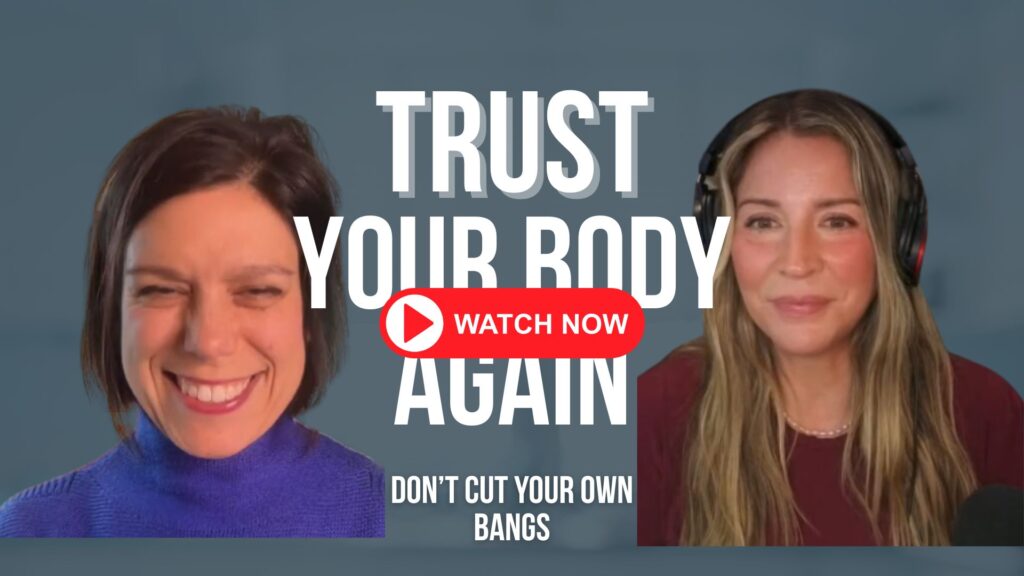
In this episode of Don’t Cut Your Own Bangs, I interview Dr. Erica Bove—a double board certified physician, fertility specialist, and coach—about something we both keep coming back to: high-achieving people often try to “think” their way through feelings. But emotions don’t respond to pressure. They respond to safety.
Learn how to process emotions with compassion and clarity—especially when you’re having a bad day, feeling stuck, or blaming yourself.
What does it mean to process emotions?
To process emotions means to notice what you’re feeling, allow it to exist without fighting it, and give it a safe way to move through you—so it doesn’t leak out sideways as irritability, anxiety, self-blame or tension in the body.
Processing is not:
Pretending you’re fine
Overanalyzing your feelings like a crime scene
Forcing positivity
Shaming yourself for being emotional
Processing is:
Naming the feeling
Locating it in your body
Allowing it to exist (it’s not as long as you think)
Letting your feeling inform your next step (not what you think you should do)
Dr. Erica says it beautifully: “Your thoughts and feelings are data.” Not flaws. Not proof you’re broken. Just information.
Why “trying harder” makes emotions worse (especially on a bad day)
If you’re a capable, driven person (bc of course you are), your default strategy when something feels off is usually: work harder, fix it faster, power through. That approach works for spreadsheets and deadlines. It’s much less effective for grief, shame, fear, disappointment, or the kind of stress that has taken up a permanent residence between your shoulders.
When you’re having a bad day, your brain is often in protection mode. Your nervous system is scanning for threat. That’s why you can feel “fine” and then suddenly… not fine. And when you respond by pushing harder, you accidentally communicate to your body: “This feeling is dangerous. We must get rid of it.”
But emotions are like toddlers. The more you scream “STOP CRYING,” the louder they get.
Or, as we joked in the episode: if your inner world is like different versions of you on a road trip, the anxious part of you is in the car … but it doesn’t get to drive.
How to process emotions with a simple 3-step method
This is the part where my high-achieving listeners are like, “Great info. Now, give me the steps.” I got you. But I’m going to say this gently: these steps are not a performance. They’re a practice.
Step 1: Name it (without turning it into your identity)
Try:
“This is disappointment.”
“This is shame.”
“This is overwhelm.” Not:
“I’m a mess.”
“I’m too much.”
“I’m failing.”
Naming creates distance. It helps you stop becoming the emotion.
Step 2: Find it in your body (data collection, not drama)
Ask:
Where do I feel this—throat, chest, stomach, jaw?
What does it feel like—tight, heavy, buzzy, hot?
If it had a color or texture, what would it be?
This is the moment a lot of people want to roll their eyes. (I say that lovingly.) But here’s why it works: your body has been holding information your mind keeps trying to outrun.
Step 3: Allow it for 90 seconds
Dr. Erica mentions something important: it can take about 90 seconds for an emotion to move through when we stop resisting it.
Try:
Take one slow breath
Let the feeling be there
Say: “I can handle this moment.”
Not forever. Just this moment.
What is self-compassion (and why it helps you process emotions)?
Self-compassion is treating yourself with the same care you would offer someone you love—especially when you’re struggling. It’s not “letting yourself off the hook.” It’s changing your inner voice from a critic to a coach.
And yes—this matters for performance too. Dr. Erica points out that research shows people often do better when they’re self-compassionate. The inner coach creates safety. The inner critic creates threat. And threat shuts down creativity, clarity, and connection.
2–3 very specific, relatable examples
Example 1: The “I’m fine” workday spiral
You’re “fine” all morning. Then one Slack message feels sharp. Your body tightens. You snap at someone you love later and think, What is wrong with me? Translation: you weren’t fine—you were bracing. You didn’t process the earlier stress, so it came out sideways.
A kinder reframe: “I’m having a bad day. My nervous system is overloaded. I need a reset, not a lecture.”
Example 2: The fertility (or health) pressure cooker
You’re doing everything “right”—tracking, researching, appointments, optimizing. But your body isn’t cooperating, and you start quietly blaming it. In the episode we talk about how trying harder often backfires in healing spaces. Your body responds to safety, not force.
A grounding question: “If I trusted my body a little more today, what would change?”
Example 3: The shame hangover after a hard moment
You cry in the car. You pick a fight. You cancel plans. And then shame shows up like, Unacceptable behavior. Do better. Instead of “why am I like this?” try: “What is this feeling trying to protect me from?” That question turns shame into information.
How to process emotions when you’re having a bad day
On a bad day, don’t aim for “fixed.” Aim for supported.
Here are a few gentle options (pick one):
Put your feelings somewhere: journal one paragraph, voice memo, notes app
Do something sensory: warm shower, cold water on wrists, a slow walk
Make one grounded action (tiny counts): tidy one surface, text one friend, step outside
Add a pinch of creativity: music, drawing, cooking, rearranging a shelf—anything that shifts your state
One of my favorite lines from this conversation: “Trying harder doesn’t work… safety does.” When you create even a small pocket of safety, your next step shows up with less effort.
That’s the shift we keep coming back to in this episode: healing responds to safety, not pressure. And you can practice that in the smallest, most ordinary moments—right in the middle of real life.
Key takeaways (to remember on a hard day):
How to process emotions starts with naming the feeling—without becoming it.
When you’re having a bad day, your nervous system needs safety first, not a lecture.
Self-compassion helps you process emotions with clarity (inner coach > inner critic).
Your thoughts and feelings are data, not flaws—and your body is communicating, not betraying you.
If this episode hit you in that tender, oh wow… that’s me place, would you do me a quick favor? Subscribe to Don’t Cut Your Own Bangs (either on YouTube or wherever you catch your podcasts), and if you’ve got 30 seconds, rate + review—it genuinely helps more people find this work when they’re searching for support.
And if someone you love is having a bad day and quietly blaming themselves for it… send them this episode. Consider it a tiny act of care that says: You’re not broken. You’re human. And you don’t have to do this alone.
RATE, REVIEW, SUBSCRIBE TO “DON’T CUT YOUR OWN BANGS”
Like your favorite recipe or song, the best things in life are shared. When you rate, review, and subscribe to this podcast, your engagement helps me connect with other listeners just like you. Plus, subscriptions just make life easier for everybody. It’s one less thing for you to think about and you can easily keep up to date on everything that’s new. So, please rate, review, and subscribe today.
DANIELLE IRELAND, LCSW
I greatly appreciate your support and engagement as part of the Don’t Cut Your Own Bangs community. Feel free to reach out with questions, comments, or anything you’d like to share. You can connect with me at any of the links below.
The Complete Conversation with Dr Erica Bove is HERE
Interview With Dr Erica Bove
[00:00:00]
[00:00:00] Before we start today, I wanna pause for a moment. This is a space that’s always been about offering levity, curiosity, and community making room for our big feelings without getting swallowed by them. And that is still true. We’re gonna keep laughing here. We’re gonna keep breathing. And I also don’t wanna pretend that what’s happening around the world or in our country isn’t affecting us.
[00:00:20] What many people are witnessing right now in Minnesota is scary and overwhelming. And alongside that fear, we are also seeing something else. We’re seeing people show up for each other. Neighbors supporting neighbors in small acts of care and kindness that truly matter. Whenever things feel this big, when emotions feel loud or hard to hold, I have learned that putting my feelings somewhere really helps, even one small, grounded action.
[00:00:46] It reminds me that I’m not powerless, that I’m a part of something bigger and I’m connected to something that is still possible for good. If you’re feeling that way too. I’ll share a resource here in the show notes, or if you’re watching, you can view on this screen and just take a screen grab and you can learn more about how to help.
[00:01:02] If that feels right to you. No pressure, just an option. Okay. Thank you for being here. Take a breath with me and now let’s get to the episode.
[00:01:12]
[00:01:12]
[00:01:19]
[00:05:37]
[00:06:31] squadcaster-181d_2_01-08-2026_101551: Ah, Dr. Erica Bove. Welcome, welcome to Don’t Cut Your Own Bangs. I, I’m going to say it, but I’ve already said it. I am so grateful for this time with you. and for everyone listening and watching to get to share this time and space with you too. So Thank you for being here.
[00:06:50] erica-bove–she-her-_1_01-08-2026_100931: I, it’s mutual and thank you so much for having me. I cannot wait for our conversation.
[00:06:55] squadcaster-181d_2_01-08-2026_101551: Yeah. So let’s jump in. You have a background in endocrinology and infertility. So you are, you’re a specialist, you’re a double threat, triple threat now because you’re a coach. and there’s so many facets, not only to your expertise, but into the healing that you want to bring into the people that you , like the community that you wanna serve.
[00:07:16] So, I just want to jump in there first, if we can kind of talk about the science of what you do, because I then wanna get into more of the intuitive pieces of what you do, which seems to be more of what you wanna fold into your coaching practice. would you mind just giving myself and the listeners through your own words a little bit more context about your work as a physician and how that’s sort of got you to here?
[00:07:46] erica-bove–she-her-_1_01-08-2026_100931: think I wanted to be a doctor since I was like a little girl. I find notes that I had of what I wanted to do and probably influenced by my family, you know, like my father’s a urologist and we lived in a small town, and so seeing his, role in the community I think was very meaningful.
[00:08:00] erica-bove–she-her-_1_01-08-2026_100931: on that path, right? I was like, okay, you know, med school, like, let’s be pre-med. I also had other interests, but my laser focus was on getting to medical school and I thought that I was going to medical school to cure the world of eating disorders, actually, because I was a
[00:08:16] erica-bove–she-her-_1_01-08-2026_100931: competitive runner and like found myself with a eating disorder in high school and college and was able to work through that.
[00:08:22] And so I was like, you know what? gonna marry these two passions of mine and I’m gonna maybe have a center like, I don’t know how this is gonna be, but I’m gonna heal the world of this problem. but I’ll tell you, like I got into medical school and I started to do my rotations and was not my thing.
[00:08:38] Like I was like, my body would not allow, I was like tired. I was like maybe borderline depressed, you know? But then I got to my OB GYN rotation and I was like not even looking at the clock, I was inspired. I liked working with my hands, like the pace was more my, my style.
[00:08:56] And so I thought to myself, okay, it was like kind of one of the first times I listened to my body and was like, what is my body asking for? it was like more of this and less of that. And so I stacked my rotations to where I was doing more of the OB GYN stuff. Absolutely loved it. And matched in a residency program in New York City and kind of had an inkling that I wanted to do like the infertility stuff.
[00:09:20] I’m gonna go to New York City. I’m gonna spend this four years in residency, do any research I need to do to match into these competitive, you know, infertility, programs. And then
[00:09:30] erica-bove–she-her-_1_01-08-2026_100931: I matched and did three more years of the fellowship and just absolutely have loved the work.
[00:09:36] It feels like my calling and the fact that I’m able to help beautiful, strong, powerful women build their families, is just such a gift.
[00:09:45] squadcaster-181d_2_01-08-2026_101551: I have long sense envied people who grew up. Knowing what they wanted to do or be, and then pursued that path I felt, I’ve heard Elizabeth Gilbert talk
[00:09:59] about people who are jackhammers and people who are hummingbirds, she described herself as a jackhammer. She was like, I knew I wanted to write, I made a declaration to God and to the universe that I was called to be a writer. And she’s obviously pursued a writing career and is thriving in it.
[00:10:12] I. Had senses like you when you were starting to talk about how your body was experiencing the field of medicine you were wanting to go into. that sense was stronger in me than knowing what I wanted to do. I just know this feels good, this doesn’t feel good, and that led me to feel, more like a hummingbird, like, well, I want a little dabble of this, and a little dash of that.
[00:10:35] I love that for you and I find I’m always really attracted to people who have that sense of them, because it sounds like what you knew then, and maybe through the lens of what you’re doing now, you are still following that sense, even though the breadcrumb trail you had from when you were a little girl.
[00:10:54] I think that’s great.
[00:10:54] erica-bove–she-her-_1_01-08-2026_100931: and I think if I were to extrapolate out a little bit more, even more than being a doctor, which I, like I said, I think was heavily influenced by I’ve always known I was a healer and, and that is the thread that I think that is, you know, continuing to, to really get me through as right now in my body, clinical medicine is not feeling the same way that it used to.
[00:11:16] And with that, I think comes a struggle with identity. I will say as I was, I’ve been an attending physician for about 10 years now. And so, you know, as I was seeing my patients, I was very disheartened with how I was able to actually help them in the context of
[00:11:30] erica-bove–she-her-_1_01-08-2026_100931: medical system that we have.
[00:11:31] And that’s really why I formed my coaching practice was to say, you know, how can I actually reach my people? How can I actually heal them instead of just delivering, like, this is your diagnosis, these are your treatment options in a very compassionate way. But that was
[00:11:45] erica-bove–she-her-_1_01-08-2026_100931: People were like, their heads were spinning, they weren’t able to make empowered choices, they weren’t getting pregnant.
[00:11:51] And so I thought to myself, okay, if my job is not just to be a doctor into my coat, but it’s to like heal the people and build their
[00:11:59] erica-bove–she-her-_1_01-08-2026_100931: I need to offer more than what I’m doing.
[00:12:02] squadcaster-181d_2_01-08-2026_101551: Well, so I a thread that I can really relate to there is you, I have over time started to understand the, with the emotional experience or the embodiment when I’m really in frustration, really in irritation. It feels similar to like this need to shed, like, I just gotta get something off. And I don’t know exactly what that is, but it feels like a shedding and I, that experience is always the step before a change that needs to be made.
[00:12:33] And it sounds like you were feeling constrained and confined within the medical container that you were operating in, and you were wanting to shed and expand. And I hope you don’t mind that I jumped to this part next. You shared with me right as we were pressing record that you resigned yesterday from your medical.
[00:12:53] erica-bove–she-her-_1_01-08-2026_100931: it was December 30th. December 30th. Yes.
[00:13:00] squadcaster-181d_2_01-08-2026_101551: So we are with you right on that growth edge of saying goodbye and closing one chapter and saying hello and fully opening, embracing this new one that I hope everybody listening who either is in a, family planning fertility journey or is adjacent to ahead of, or supporting someone who’s also on that journey, that this is an incredible resource for them.
[00:13:27] And also too, I just wanna say , for anybody listening who knows, you don’t want children, I don’t want you to turn this episode off. Please stay with us because there’s so much more to Erica and there’s so much more to this conversation about. Listening to your body, trusting your inner knowing, but also like blending the science or with, as to the best of our understanding, like this is also about like medical advocacy.
[00:13:53] Like there’s so many threads that are gonna come through this conversation beyond getting pregnant and having a baby. But that is the foundation, but that is not, not limited to that so I just wanna forecast that for anybody who might thinking this doesn’t apply to them.
[00:14:07] ’cause it does, it does. Yeah. Yes, okay. I want to speak a little bit to, or rather open up the conversation to let you speak a little bit to the listener who is a capable, driven, quietly exhausted woman who is crushing her goals, who is highly intelligent, who is silently suffering and struggling because.
[00:14:32] Something isn’t happening with her body in the way she wants it to. And that’s really where you meet people.
[00:14:40] So I think the first thing to understand is that for high achieving women, the equation, if you will, of what’s worked to get people successful is not going to work in the fertility space.
[00:14:52] and like we’re supposed to be good at everything that we do.
[00:14:55] assumption is if we just work a little harder, if we go down the Google rabbit hole a little bit farther, that we’re gonna figure it out and we’re gonna sort of, force this to happen almost. And so the first thing to understand is calming the nervous system, connecting with the deepest why, really understanding why that desire is in your heart to have a little one, right?
[00:15:17] erica-bove–she-her-_1_01-08-2026_100931: deep, deep desire and that deep motivation getting into the body, because we’re also cerebral and this analysis paralysis that we have, and this like just rumination about all of this, we have to drop into the body. that’s sort of the next thing, and in a safe space, right?
[00:15:33] We have to create that safety, and that’s when we can start to say, okay, like what is my body actually asking for? For some people it’s treatment. For some people it’s not treatment, right?
[00:15:46] squadcaster-181d_2_01-08-2026_101551: I wanna get a little granular in that. Asking the body what it wants, what it’s asking for, that question has an esoteric almost. Spiritual spin to it. And I have in sessions with my own clients, you know, it’s like, where does your anxiety live in your body?
[00:16:04] Where do you experience? What age is it? What is it maybe trying to tell you that you’re not listening to? Those are all questions that I love asking, but for this particular type of woman, this high achieving. and I’ll say too, I, because I work with men and women, that type of question, it’s like, well, just tell me what to do.
[00:16:20] Tell me what to say. I’m very logical, critical thinker, solutions focused. Just give me the steps. And those questions usually create like a conversational record scratch. so how do you invite that to somebody who thinks they’re coming to a doctor to get medical advice, and you’re like, what is the wisdom of your body wanting you to know,
[00:16:40] erica-bove–she-her-_1_01-08-2026_100931: and you know, this is something I was taught to do and so I’m so grateful to my teachers for teaching me how to feel my feelings And I think this appeals to many people who are very analytical. And I’m like, our thoughts and our feelings are data. They’re data, data.
[00:16:52] They are teaching us things about us that we need to know and, and we, in trauma, I mean trauma is intimately linked with infertility. We store things in our body that we don’t even realize. And so how can we reconnect the mind and the body in a way that allows us to move forward with this journey? And you know, it’s not about trying harder, it’s about receiving and connecting Helping people to start to feel their feelings is one of the first things we do. Because when we resist a feeling, when we avoid a feeling, those feelings stick around and they come out in strange ways. Right? That irritability, that, that frustration, that, sort of disconnection, withdrawal. And when we start to say, oh, I think there’s shame living in my body just like you. I say, okay, tell me about the shame. Where is it physically? What color is it? What, texture is it? does it feel like? Can we breathe until we do breath work? Can we breathe into that emotion and see just if it changes just a little bit, if it just can loosen its grip just a little bit. then when we do this discipline of feeling the full range of the human emotions, if we’re in the fertility clinic and we say we get a, a negative result or say. are, with our partners and we have a disagreement about the next steps. Like, we’re like, oh, that’s just disappointment. I, I, I understand disappointment. I can feel that, oh,, that’s not, I don’t mean to minimize, I think that’s just shame, but oh,
[00:18:24] erica-bove–she-her-_1_01-08-2026_100931: tell, tell me what you have to teach me today about this situation.
[00:18:28] And when we can really drop into our bodies and take the 90 seconds it takes to feel a feeling and let it go, then we can get the clarity of what we need to do next from the emotional standpoint. And then there’s the science too. But we have to feel safe in our bodies. We have to process the feelings before we
[00:18:45] erica-bove–she-her-_1_01-08-2026_100931: to think about the confidence in the treatment plan
[00:18:48] squadcaster-181d_2_01-08-2026_101551: I love , anytime something that I already think I know is iterated and reiterated in a way that feels familiar and new. So what I heard in what you just said reminds me so much of acceptance and commitment therapy that first we have to allow the feeling to exist, acknowledge the feeling’s, existence, and then feel it.
[00:19:11] And that is so much easier said than done. But that 1, 2, 3 punch is when I think, when people sort of collectively talk about doing the work. That is the work. And the benefit of that is when you can see name and know your experience. Then you are in the driver’s seat.
[00:19:31] I always think of visually that I, and this, I’m definitely gonna be dating myself, so I apologize, you know, younger, younger listeners. but there’s a music video by Alanis Morris set where she’s playing different characters and they’re all on a road trip. But I love that visual of, there’s a version of me behind the wheel.
[00:19:48] There’s a version of me in the backseat, like that’s a terrible backseat driver that’s criticizing everything the driver’s doing. There’s a version of me in the backseat that’s like whining and bored and uncomfortable and hungry and just wants it to be over and always has to pee. There’s a version of me in the, like, there’s all these different versions of me and this is now talking about parts work or internal family systems.
[00:20:06] But yeah, I love that all those different parts of you have a voice and they want to be acknowledged and even just acknowledging that they’re there, I find it dials the volume down of whatever they’re screaming at you by like half instantly. And then to your point, the next right step almost reveals itself without much efforting behind it.
[00:20:29] But I think what we love to do is put the doing before and then just hope that we can kind of trudge through and push through, and that never feels quite so good.
[00:20:41] erica-bove–she-her-_1_01-08-2026_100931: almost like an unlearning of what has worked in the past and then a relearning of, of what this is. And I always say to my clients, I’m like, we need to thank the feelings. Obviously if it’s authentic, like if it’s anxiety or
[00:20:52] erica-bove–she-her-_1_01-08-2026_100931: , This really protective instinct like say, thank you for trying to protect me. I’ve got me now. you for being here. I see you. I see you’re trying to help. And I’m the wise leader of my inner world. I’ve got this situation. I don’t need you to be so loud anymore. You can still be on my bus, but I need you to pipe down right now because I’ve got this
[00:21:09] squadcaster-181d_2_01-08-2026_101551: Well, I mean, it’s like a kid throwing a tantrum in a car seat. It’s like you wanna acknowledge their existence, but I’m not gonna let my child drive like my four, my 4-year-old should not be behind the wheel of the car, even though every time we turn the car off, she loves getting in that driver’s seat.
[00:22:38] squadcaster-181d_2_01-08-2026_101551: so an experience I wanna share and get your take on, and then as well as a question I wanna ask, because the thing I’m curious about is the gap you saw and the need you’re trying to fill and the one that you felt compelled to fill, where, this is what science, western medicine, my expertise in training, and then there is this gap, but there’s also these other resources and it’s almost like you’ve created a bridge or you are serving as a bridge between these two.
[00:23:05] I have my own personal experience of. Deciding that I wanted to get pregnant. I wrestled with that for a really long time. ’cause I wasn’t sure if the idea was mine or if I was conditioned to want it. And so I, and that’s, I think that’s the constant lesson and relearning for me, is bringing the conversation in my head into my body and letting my body be a part of the conversation.
[00:23:28] Letting my heart be a part of the conversation. Because in my head, I, I could pro list, pro con list anything to death, and that’s exhausting and tiresome and not fun. But I felt this, it was almost like this crunch of these four walls coming in one wall was biological clock because I was. Having this conversation around 31.
[00:23:47] And of course once you, once you turn 30, it feels like I live in the Midwest. I turned 30, I’m married. And everyone was like, TikTok,. that was exhausting. But, so there’s that factor, the biological age factor. And by the way, I was a geriatric pregnancy both times that I, well actually when I miscarried, I was a geriatric pregnancy.
[00:24:05] And then I had two beautiful babes. Um, all, all geriatrics,
[00:24:10] erica-bove–she-her-_1_01-08-2026_100931: way, is a bill. Can I just call out that that’s a billing term? Like that’s not
[00:24:14] squadcaster-181d_2_01-08-2026_101551: that
[00:24:14] erica-bove–she-her-_1_01-08-2026_100931: Like that’s just, we just need to
[00:24:16] erica-bove–she-her-_1_01-08-2026_100931: take that out of our vocabulary.
[00:24:17] squadcaster-181d_2_01-08-2026_101551: my doctor, my ob GYN, God love her. ’cause I do love her. She is a gem. I didn’t realize how lucky I had it until I started hearing other women’s stories and experiences, but I think doctors like you, like Dr. Katie Lynn, I could sing their praises forever. But anyway, she had to say that term so that I wouldn’t be shocked by it if I saw it.
[00:24:38] But then she very quickly nullified and like she contextualized it, but it was hard to get it outta my head. So anyway, I digress. so felt the pressure of that. And then I had just entered into a new field, so right before we decided to start trying in the, you know, that sense of the word, I just graduated with my therapy degree and started working in my private practice and.
[00:25:03] so I wanna build a life for myself. I feel like I’ve just declared my flag and stuck my stake in the ground. My age is coming up. There’s pressures from the world and I didn’t even know. If I wanted or didn’t want it, and all of those things converging. And then once my husband and I started trying, because of the way that, all of the things that are wrong with sex education in school, the fear was, you know, if you look at a penis for too long, you could get pregnant.
[00:25:28] and so I thought, okay, we’re gonna lift the shield, and everything’s gonna go. And it, it didn’t. It played with my mind , I’m happy to talk in more detail about how I knew I wanted to get pregnant, what that experience was in more detail.
[00:25:40] I’m not trying to gate keep anything, but just for sake of, of this conversation. So anyone listening, please feel free to email me if you want an episode where I flush that out more. But once I decided to get pregnant, it took about eight months to get pregnant the first time.
[00:25:53] I was working way too much. I had no idea that I was, I knew burnout as a concept, but I didn’t put myself in that concept. I was somebody who was in a helping profession that was absolutely not taking my own medicine. I was completely blind to my own over-functioning, overworking over caffeinating, overdoing self.
[00:26:13] I wasn’t making any space for my body or this journey. And then miscarried at 12 weeks. that whole process rocked my world. I did record an episode where I talked about that in detail. If anybody wants to listen, I’m happy to relink it.
[00:26:26] erica-bove–she-her-_1_01-08-2026_100931: And I’m
[00:26:27] just have to say, I’ve gone through it too, and for anybody listening who’s had this experience, it’s terrible and you’re not alone.
[00:26:38] squadcaster-181d_2_01-08-2026_101551: thank you. The meaning that I make from it and where it continues to shine light for me, in addition to all of the pain, is the opportunity to share it and remind people they’re not alone in it. So it adds value to my life to talk about it. thank you.
[00:26:53] I received that and thank you so much. then once we decided that we were going to continue to try, which was a whole conversation and I had to let my body heal. That grief and that experience was A real pivot for me in how I looked at my body, how I looked at my work and how I wanted to operate this body through my life.
[00:27:16] And so what I realized then that is also kind of bookending with the stage of life I’m in now, was I was living so compartmentalized and fractured. This is who I am in this space. This is who I am in this space. Rather than integrating I am all of me all of the time and I’m always carrying me with me.
[00:27:33] And so that more holistic, I’ll say more well-rounded view of myself and how I wanted to be, brought me to acupuncture. So I was simultaneously starting to think about fertility treatments ‘ cause I, nothing was medically with my husband or myself, nothing. Nothing was off in terms of what they saw or what they knew.
[00:27:53] erica-bove–she-her-_1_01-08-2026_100931: everything checks out on
[00:27:54] doesn’t mean there’s not a problem, right? , Right. So, but like from through the lens that like all my doctors were saying, there’s nothing wrong with you. There’s nothing wrong with your husband. Your swimmers are swimming and your eggs are egging and everything should be fine.
[00:28:06] so, but I was making all of these other appointments while also I began acupuncture. And it just, it was humbling how much I thought I knew that I didn’t really know, and the how much I wasn’t really listening to my body. And, it, it created like a whole shift in my life
[00:28:24] erica-bove–she-her-_1_01-08-2026_100931: I mean,
[00:28:25] this
[00:28:25] common pattern that I see and I, I’m grateful that you were able to do it on your own. You know, some people are not, and I think to go back to that younger version of yourself who was doing what she was taught is the right thing to, you know, get your degree, work harder, serve the people, be a good wife, like you were checking all those boxes of like the good girl and like what people who are successful do. And
[00:28:50] erica-bove–she-her-_1_01-08-2026_100931: does not equate to. Having a fertile life. For some people, they’re able to get pregnant in that context. I understand things happen, but for so many people there’s a block on the process and, it’s almost like there’s no space. Like we talk about decluttering our closets and our drawers and everything, and I’m a single person, right?
[00:29:09] Like I am interested in like the dating world and, and they say if you are interested in dating, let’s use that analogy,
[00:29:15] erica-bove–she-her-_1_01-08-2026_100931: things in pairs. Start to clean out your closet so that there’s room. I bought a set of like two chairs because I was like, oh, that sounds like lovely. And it’s like not just one chair, but it’s two.
[00:29:24] And I think the same thing applies to when people are trying to get pregnant. I say, imagine yourself as that pregnant person and that new mom. Does your life now have the space to hold that? And if it doesn’t, we need to find a way to create that. Maybe it’s leaving a job, maybe
[00:29:42] erica-bove–she-her-_1_01-08-2026_100931: Maybe it’s finding time to meditate and, and spend time in nature and create creativity. Actually creativity is one of the threads. Once people start to get creative. This process is gonna happen soon. Like I just, I see it. yeah.
[00:29:53] squadcaster-181d_2_01-08-2026_101551: Martha Beck, wrote the book The Way of Integrity, which I recommend to people all the time, but the one that she just published after that, it Anxiety is in the title, but the title itself is escaping me. But what she says in that book, and I’ve actually seen her lecture on it in person, and it just, I can’t say it enough because I’m still practicing it.
[00:30:11] The opposite of anxiety is not calm, it is creativity. When we’re pursuing peace and calm and serenity and zen and all those things, and I love mindfulness and I love meditation, but one of the quickest and most direct ways you can dial down the volume of anxiety in your mind and in your life is to engage in something creative.
[00:30:29] And that can be literally anything. But I love that you said that. ’cause you are creating with your body.
[00:30:35] erica-bove–she-her-_1_01-08-2026_100931: And I think that, when you did that, then things started to happen and that is the pattern that I see for so many people. But it’s uncomfortable. I would, I just have to call out like it’s really uncomfortable to step back or to feel like you’re not pulling your weight or you’re not doing what your degree says you should do, or what society says.
[00:30:53] There’s a lot of countercultural to this and so.
[00:30:57] erica-bove–she-her-_1_01-08-2026_100931: where we have to tune into our bias and say, I know society says one thing about how this should look. You know, in my community, we normalize all these things, which is, I think, helpful, but that’s where the wisdom of the body comes in because it’s like, okay, my nervous system doesn’t work this way.
[00:31:10] I need to up the channels. and with that comes that reduction in hypervigilance. We started to talk before about, why, what was I seeing? And it was,
[00:31:21] erica-bove–she-her-_1_01-08-2026_100931: people, we were in a conversation just like this, right? But like, I could see that my words weren’t landing. I could see
[00:31:28] erica-bove–she-her-_1_01-08-2026_100931: the anxiety that people were maybe absorbing 10% of what I was saying.
[00:31:32] I slowed my voice and I checked for understanding, and I tried every single thing. I knew what to do. And I realized like, until their nervous system is in a better place, and until they can connect with themselves at the deepest level, this is
[00:31:51] erica-bove–she-her-_1_01-08-2026_100931: So I was taking care of a woman recently and, you know, unfortunately this woman had a long history of trauma and she had done a number of insemination without success and even did in vitro fertilization without success. And I was the one who did her transfer. A lot went into it.
[00:32:07] I remember meeting with her in the office afterwards, like her arms were crossed. She was shut down. She was really defeated and just really in a negative place. And she said , I don’t trust anybody. I don’t trust the world. I really wanna
[00:32:20] erica-bove–she-her-_1_01-08-2026_100931: mom more than anything. But , I just, I don’t understand why this isn’t working, but , it should be working and it’s not.
[00:32:25] And I, I’m high achieving, like, I dunno what else to do. so I remember we had a heart to heart. So then that was one conversation. She came back for, another conversation before her next transfer. I could just feel the hypervigilance. I could feel the negative energy again. No blame. But it
[00:32:50] erica-bove–she-her-_1_01-08-2026_100931: To let this happen for her. So we met closer to the time of her embryo transfer and I said, I know you’ve been through so much and know, if we can just crack open the door to possibility, if we can just say, you know, I, I know that a lot’s happened and I know that, you’ve lost trust in us, in the system. Like I need some connection here for this to work. I believe
[00:33:12] erica-bove–she-her-_1_01-08-2026_100931: but we have to, I need you to reduce the hypervigilance. I need us to be able to find a way through. And she said, well, I have a hard time trusting the team. honestly,
[00:33:23] erica-bove–she-her-_1_01-08-2026_100931: I’m a person who will push, push, push until I get what I want. But I do inherently trust that my body is going to do this. And I said to her, I
[00:33:31] erica-bove–she-her-_1_01-08-2026_100931: I believe that’s enough. I think we should move forward. I was the one on call, when her embryo chancellor came, and I felt the negative energy in the room. I can feel energy. That’s part of my empath
[00:33:44] erica-bove–she-her-_1_01-08-2026_100931: And almost as if I was in an epic battle. I remember I got the speculum in, I did the cleaning, I put the catheter transfer in, I got the embr
[00:33:53] erica-bove–she-her-_1_01-08-2026_100931: And it was almost like, there’s like epic battles where you feel like there’s the sword and then you see like all the things
[00:34:00] erica-bove–she-her-_1_01-08-2026_100931: I was like holding it, holding it. And like I felt it recede. And in the room, I knew, I was like, I get chills thinking about it. I’m like, this is gonna work. This is the one that’s gonna work because she’s opened herself up to it. This is the one
[00:34:14] erica-bove–she-her-_1_01-08-2026_100931: would you believe, a week and a half later as we do, we checked the pregnancy hormone level. It was great. We checked it again. It was great. my whole team was like amazed. They’re like, you did it. And I’m like,
[00:34:35] erica-bove–she-her-_1_01-08-2026_100931: best case scenario if you tru trust your doctor. Not everybody can do that, especially if people have a lot of medical trauma. But if you can open the door of some belief, some possibility, some trust in the body that it will do what it’s supposed to do, that’s when I see the magic start to happen.
[00:34:52] So I think that’s a really good example, of the energy
[00:34:54] squadcaster-181d_2_01-08-2026_101551: I love
[00:34:55] squadcaster-181d_2_01-08-2026_101551: I love that. And I’m so grateful that you’re inviting that component in. And a correlation that I made as you were describing it, is this idea of controlling the body versus listening and trusting the body. And I can also see how that relates to the work of eating disorder recovery.
[00:35:13] and this nature of the world feels out of control. I feel out of control in the world, and I can control this, this container. I can control its size, what it consumes, how often it moves that I can control. which, and of course, like anybody who is living with or in recovery from or works in eating disorder, I know there’s different types and, and that’s not a blanket statement of truth for every type, but for, this conversation about trusting the body and feeling safe enough in your body to trust that it has the wisdom that you need. I find that, so I could never hear enough stories like that, and that’s honestly, truly selfishly why the podcast feels not only in service, in ways that fulfill my heart for the community, but also it serves me.
[00:36:04] I need to fill up my days, my mind, my life with this many stories like that of, you know, I’m moving through the world, doing the best I can, and then there is this unnameable, unknowable magic that lifts something off. Like, I need to be in touch with that in some way. .
[00:36:21] I love that. Thank you for that story. That was beautiful.
[00:36:25] erica-bove–she-her-_1_01-08-2026_100931: I think it’s that combination. So my coaching practice is called Love and Science. we start with the love, we feel, we start with the safety. I help people love themselves, which I know you do in your practice as well, right? that self-compassion has to start there. And then we bring in the scientific knowledge. you’re this many years old and this is how long you’ve been trying and this is what your testing shows. and I find that when we start with the love and the safety, that’s when that information can really land and people. Deeply understand what’s going on with their bodies.
[00:36:53] It’s when they can start to make the empowered choices because they’re able to absorb it, because they’re able to ask higher level questions. And there’s the space, right? That word against space. The space to be able to do that. And it’s not always, oh, you need IVF, you know, sometimes
[00:37:20] erica-bove–she-her-_1_01-08-2026_100931: shift, I think is the important thing. And unless we can help people with that piece of it, then We’re missing the point.
[00:37:27] squadcaster-181d_2_01-08-2026_101551: So I want to, how would anybody listening who, if there was something that they could begin to do. they’re relating to what you’re saying. They’re excited by what they’re hearing in this conversation, and they’re feeling out of control or they’re inflicting a lot of self blame in these silent conversations in their head.
[00:37:50] I think I’m referencing Elizabeth Gilbert here when she says that sometimes my mind is like a bad neighborhood that I’ve found myself walking through alone at night. And so wanting to help make the mental space a friendlier place to be. When we are in those spaces where we feel out of control and we’re being so hard on ourselves, what would be a step in, or like, how can we get a foothold into dropping into that trust that we’re talking about?
[00:38:19] erica-bove–she-her-_1_01-08-2026_100931: that’s such a great question. I think one of the best ways is to get a guide. I have this course that’s available for people, but
[00:38:25] erica-bove–she-her-_1_01-08-2026_100931: the easiest place to start would be to get the Mindful Self-Compassion Workbook by Dr.
[00:38:30] Kristen Neff because it’s a very interactive workbook. It starts to introduce the concepts of self-compassion. It goes through the mindfulness, the self-kindness, the common humanity in ways that I think people can really. Relate to and be like, oh, I’m not alone in this. It makes sense that self-judgment like, oh, I just am not handling this well enough.
[00:38:51] really applying that workbook to the fertility situation, I think can be a really great place to start to become acquainted with mindful self-compassion. there is a lot of resistance I’ve seen and myself included when I first started doing
[00:39:04] erica-bove–she-her-_1_01-08-2026_100931: of like, well, I’m gonna be soft or I’m gonna lose my edge.
[00:39:07] And, and, and she talks about that in her workbook as trying on a dress or a blinker or something, a new pair of shoes, and if it fits, if it starts to work, then we do more of that thing.
[00:39:16] So it’s just, I think of it as , this is a thought experiment. This is, this is just trying this on. And if this
[00:39:23] erica-bove–she-her-_1_01-08-2026_100931: is resonating. Then lean in and see what it might have to offer you. But I really do think the best
[00:39:28] erica-bove–she-her-_1_01-08-2026_100931: to invest in yourself, to start to work with a guide, because this is deep stuff and sometimes some deep things come up as we’re uncovering this when we’re learning to live a different way.
[00:39:39] And so that combination, I think is really powerful.
[00:39:43] squadcaster-181d_2_01-08-2026_101551: That is great. And it reminds me too, of this idea that we spend so many minutes, hours and a day being hard on ourselves. That drill sergeant is really screaming at us throughout the day that why not offer a drop of compassion? It’s like a drop in the bucket by comparison. And one of the things that I like to remind clients that I work with and myself, I’m including myself in this, that so often.
[00:40:11] what we’re responding to is something that feels familiar, not something that is wanted. And so the more we can embody the experiences and the more we can really tap into what feels like warmth, what feels like an opening, what feels like a lightning versus what feels like a constricting or a tightening, or a binding or an edge.
[00:40:32] there’s such a difference between feeling charged and tight, like bracing yourself to get hit versus feeling. Open and receptive. But again, what feels familiar often gets conflated or confused with what is wanted. This feels like home to me. Okay, well, did you like your home environment?
[00:40:51] Would you want your home environment for your child? Having my kids, has brought a tremendous amount. It’s rather called forth and volunteered me in ways I didn’t think I was ready for to do my own inner child healing work because. We carry ourselves with us through every stage of life.
[00:41:09] So it all just feels like one big blob. But seeing a 4-year-old and imagining, oh my God, I would never say the things I’m saying to myself, to her. And I actually have for a point of reference, a photo of myself at four that I keep,
[00:41:20] erica-bove–she-her-_1_01-08-2026_100931: so
[00:41:21] squadcaster-181d_2_01-08-2026_101551: Thank you. I keep her on my desk so that when I’m being hard on myself, I’m being hard on her too.
[00:41:26] I, we can’t com as as smart as we are, compartmentalizing ourselves that way. Even if it’s possible, it’s not sustainable. I wouldn’t say it’s a great goal.
[00:41:35] erica-bove–she-her-_1_01-08-2026_100931: Another way that I get buy-in from my people about this notion of self-compassion is
[00:41:39] erica-bove–she-her-_1_01-08-2026_100931: data actually shows that people’s performance actually improves when we’re self-compassionate. And that’s the interesting thing I would say that shouldn’t, be the motivation, oh, I’m doing the self-compassion thing because I’m gonna, perform better at my job, et cetera. But I think if people have that worry that it’s gonna make them soft, that it’s gonna, make them lose their edge. the inner coach is so much. better than the inner critic. And so that’s what we’re doing, right? We’re saying, okay, We all have a very strong inner critic that helped us at one point in our lives, helped us survive. And,
[00:42:09] erica-bove–she-her-_1_01-08-2026_100931: transition that through mindful self-compassion to an inner coach who’s you’ve got this, you’re doing your best, great job. what’s your next growth edge? Those are such different questions than like, you suck, you’re a horrible person.
[00:42:22] Why do you even try? everybody else is doing it better than you are. you’re not doing it right. all those different things that we say to ourselves. And so the research shows that the areas in our brain that are, linked to success, that those areas actually do better when we’re, introducing this concept.
[00:42:40] erica-bove–she-her-_1_01-08-2026_100931: it helps me feel safe of like, okay, I’m gonna try this on and I’m going to gain, I’m not going to lose.
[00:42:46] squadcaster-181d_2_01-08-2026_101551: And when people are afraid, creativity shuts down. it limits your capacity to access all the parts of our brain that very smart, high functioning people like to think it’s like I’m all frontal lobe all the time. not, if you’re living in terror or constantly re terrorizing yourself.
[00:43:00] erica-bove–she-her-_1_01-08-2026_100931: high level decisions when we’re in that fight or flight state.
[00:43:03] erica-bove–she-her-_1_01-08-2026_100931: is a constant threat. I say, yes, if you’re being chased by a bear, you want that sympathetic response, but
[00:43:08] erica-bove–she-her-_1_01-08-2026_100931: chased by a bear for like five years daily? You know what I’m saying?
[00:43:12] Like, that’s not good. And I find that when people are able to, relax into the process in a safe space to trust their bodies, to trust their teams, to allow this process to happen, that’s when the adrenals calm down. That’s when the sympathetic nervous system tones down.
[00:43:29] And that’s when we start to see this working. The hyper vigilance is counterproductive.
[00:43:35] erica-bove–she-her-_1_01-08-2026_100931: judge ourselves for that, but we should just understand there’s something we can do about that. those tools are.
[00:43:41] squadcaster-181d_2_01-08-2026_101551: Yes. I, there’s so many things that you said that I, I wanna re re-highlight too, that you didn’t say it this way, but I, the language of essentially emotions are energy and motion, and they always have something to tell you. Their emotions always have something to tell you, but that’s where I think.
[00:43:59] Bringing the mind and the heart and the body together again, that’s your science and your intuition and your coaching practice together, that we’re not trying to encourage anyone to abandon any part of yourself for the service of another. Because if we’re all feelings all the time, then we’re wasting this supercomputer that we, that we have.
[00:44:19] That’s an incredible, incredible tool. It’s incredible part of us too. But so many of us wanna just operate from the chin up and completely like vote the body off the island. the other thing that I think the language that I like to introduce when somebody is in this pocket of how do I begin this process?
[00:44:38] Or I thought I knew how to do it, but there’s this one part of my life where I just keep hitting wall after wall after wall. I call it compassionate curiosity. some of that is language I borrowed from Brene Brown. I’ve also borrowed a little bit from Byron Katie. But there’s four questions that I love to introduce because I find that.
[00:44:55] I feel more open, more receptive, and I’m more able to trust the information that comes to me when I’m in a curious state as opposed to a critical state or if I’m trying to be certain. The more locked into certainty I am, the more the controlling part of me is engaged, and then I am not open to anything.
[00:45:13] But the first thing is, is that true? Is that true? That thought you have about yourself and the world? Is that true? And then the follow up, can you absolutely know with a hundred percent certainty or sometimes raise the stakes with, would you bet a million dollars on the truth of that statement? is there anything truer that you could find or that you could say?
[00:45:33] And then you start to question what you feel so certain about. ’cause a belief is just a thought. You keep thinking over and over. And when the beliefs you have start to erode, that’s incredibly vulnerable, but that’s also the rocket fuel for transformation and growth. so I can already feel myself like wanting to go down so many other threads of conversation with you, which just means I need to have you back.
[00:45:55] I do wanna make time for us to dive into your, don’t cut your own bang moment because you teased out a little bit of it for me, and I wanna give that. Thread as much space as it needs. ’cause I think it’s gonna be really good and incredibly relatable. But, I don’t want you to feel pressure about the stakes here, but I really would love to hear your, don’t cut your own bang moment.
[00:46:16] erica-bove–she-her-_1_01-08-2026_100931: absolutely. So, well, I actually did cut my own bangs when I was seven,
[00:46:21] erica-bove–she-her-_1_01-08-2026_100931: my youngest sibling. and my father had three of us at home. He was on the phone. I said, dad, can I cut my bangs? And he said, yes. He was saying yes to the person on the phone, not to me. I’m gonna also preface this by saying it was the night before Easter Sunday and we’re a Catholic family and that was interesting.
[00:46:40] erica-bove–she-her-_1_01-08-2026_100931: So I like literally cut my own bangs in this very diagonal fashion, and it was just a very memorable 7-year-old experience. but let’s talk about that like adult moment of not cutting my own bang.
[00:46:51] erica-bove–she-her-_1_01-08-2026_100931: I was on the straight and narrow pathway. Like I didn’t take any time off between college and med school.
[00:46:55] I went to med school and I think I was told I was gonna be infertile, so there’s that. And I think I started to feel my biological clock ticking and I was like, okay, about to start residency. Need to find a husband and
[00:47:07] squadcaster-181d_2_01-08-2026_101551: Wait, you were told you were going to be infertile,
[00:47:14] erica-bove–she-her-_1_01-08-2026_100931: I was told that I would be infertile and it was like this, male doctor who I think was like the opposite of how you should give, bad news. And so I learned a lot from that, but it was very disconcerting and, is relating to PCOS and hypothalamic amenorrhea. Knowing what
[00:47:32] erica-bove–she-her-_1_01-08-2026_100931: like I would never tell a patient those things, but it planted the seed in my mind. Like, if you want to have kids like you better get on this because it might be really hard. that’s more than being a doctor. I’ve always wanted to be a mom, and so I. hadn’t really even dated that much at that point because I was like always so focused on my achievements. And
[00:47:52] erica-bove–she-her-_1_01-08-2026_100931: was at, a Good Friday service, and I met this guy in the back of a church. I was there for the service. He was there for the free food. We connected, I know we connected. And then somehow things, we fell in love like very quickly.
[00:48:06] erica-bove–she-her-_1_01-08-2026_100931: got sick somewhere in the process with melanoma and we were engaged at like 10 months. And we were married a year later before I even graduated medical school. And I was like
[00:48:18] erica-bove–she-her-_1_01-08-2026_100931: and like we were doing this whole thing because he was a graduate chemistry student.
[00:48:23] I was a medical student. I knew that I’d be starting my internship somewhere. I met him in my second, third year of med school. When you’re starting the process of like, where might I apply? So we spent an inordinate amount of time being like he wanted to go to medical school. Okay.
[00:48:37] Medical schools for him in this geographic area. Residencies for me. We had all these elaborate whiteboards and everything to plan this,
[00:48:45] erica-bove–she-her-_1_01-08-2026_100931: got married my fourth year of med school. And I’ll say, I had seen some red flags, , along the way, like there was a Valentine’s Day where he had an outburst and we were crying.
[00:48:55] I was crying and then we were late to the restaurant and then. The actual night before my wedding, I like, didn’t sleep at all. I cried the entire night. I was like up crying , my brain. I was like, oh, it’s just because like I’m becoming a woman and an adult and this is a big deal and I’m in my childhood bed and but I, I cried like truly like the whole night before my wedding. So we got married, we took a honeymoon, we went to Italy, we rented a villa in Tuscany, which on paper looks, sounds wonderful, I got there and , we rented a car. There was road rage. I felt so lonely and I was just like, oh my God. What did I just do? Like I just married this person and I think we were so focused on like the logistics and getting married before his mom passed away and me potentially being infertile and all these things. I started to see sides of him like immediately on the honeymoon where I was just like. What did I just
[00:49:47] erica-bove–she-her-_1_01-08-2026_100931: but I was like, maybe it’s just me and maybe it’s my fourth year of med school and maybe blah, blah, blah,, all the things. And intern year I was just focusing on survival. so that went on.
[00:49:56] But I think the point is I did that thing, which was like, got married, had the big wedding, so many people with my giant family, but immediately afterwards, like really understood that it was gonna be problematic for me. I would say everybody listening can relate to you had an experience that didn’t feel good, that didn’t fit your narrative, so you had to make an explanation for it.
[00:50:19] Yep.
[00:50:20] squadcaster-181d_2_01-08-2026_101551: you made allowances and explanations, and I just, what was coming up for me so strongly.
[00:50:25] it reminded me of, when I lost my virginity, but it wasn’t by my choice. It was somebody I was dating, it was assault. but I couldn’t let myself see that at the time because it didn’t fit the narrative. Of what it meant when somebody said, I love you, what it meant with your first, your first boyfriend.
[00:50:46] it didn’t fit that. And so my form of self-protection was to make it fit. But of course, the wisdom of my body, my body knew that what was happening didn’t feel good. My tears let me know this wasn’t feeling good. Like my body was showing, its revealing its truth to me, but I dissociated from it. Which again, I can say that, and by the way, I can talk about this so openly ’cause I’ve done so much healing around it.
[00:51:13] So anybody listening, this is not something I’m taking lightly. It’s just something I can hold lightly in my hand because it doesn’t hold the weight. It did once upon a time for me. But because so many of us, and I’ll say women in particular, are trained to look outside of us for who and how we should be not listening from within first.
[00:51:36] And so my experience was, well, this is what he’s saying and this is what I was told and this is what I’ve learned and this is what life and Disney has shown me. How can I take the Play-Doh of this raw, horrible moment and just fit it, smash it in the mold of what I need it to be so that I can keep a story that feels better.
[00:51:58] And then it was two years later I was in college and I was in a much healthier relationship. I’d say probably my first healthy relationship I remember it was when, Kobe Bryant was being, accused of assault and that conversation was all over the place. Everybody was talking about it.
[00:52:20] I remember constantly feeling like I was overhearing people, talking about that moment and had all of these big opinions about what assault was, what it wasn’t, how it should look, how it does look, how it couldn’t look. we can insert fertility, we can insert motherhood, we can insert marriage, like insert a topic.
[00:52:36] But like the bullets on the outline of that emotional thread. And it all came crashing down on me, the truth that I wasn’t allowing myself to see. And then I felt it all two years after. And then there were all these waves of shame of. how did I not know? I wasn’t in touch with him anymore.
[00:52:55] I couldn’t hold, like there was just, I had to hold all this experience and I had nowhere to put it. And so it came out in all kinds of ways. and just to bring it back to your experience, I speak with women all the time who, on the day of their wedding, the first day of their honeymoon, have that inner knowing where they drop into, oh, no.
[00:53:19] and that is so much more common than I think anybody acknowledges. So I just wanna thank you for being so open and vulnerable in that way. if you wouldn’t mind if we can go back to your story for a moment. how did you find your way outta that? ’cause you mentioned that you were single.
[00:53:37] erica-bove–she-her-_1_01-08-2026_100931: I am single now, so I was like, when I was an intern, I was, what, 26 years old? And I was really just so focused on survival. I was working like a hundred hours a week and he was a medical student.
[00:53:46] squadcaster-181d_2_01-08-2026_101551: Oh my God.
[00:53:47] erica-bove–she-her-_1_01-08-2026_100931: pregnancy was a miscarriage. We, oh my gosh, Danielle, we navigated, we had like a flood in our apartment, ? We live in New York City, and so like somebody, two floors above and had a fire, and all the water came crashing through the light fixtures. So we had a flood, we had a fire, we got in a car accident, we got sued. like all these different things that happened in the midst of this, like being, , his mom died, , in year, like we just had so many hard things that happened in such a short
[00:54:14] erica-bove–she-her-_1_01-08-2026_100931: the miscarriage. I knew I wanted to have a family. I got pregnant my third year of residency with my older son, Lincoln. and that pregnancy stayed. So then I was navigating new motherhood as a chief resident. and that’s really when I think, when we are married to people who have, tendencies, I think that, when the attention is on them, it’s okay.
[00:54:34] Right? , Like it’s, it’s not okay, but the universe continues on. when
[00:54:39] erica-bove–she-her-_1_01-08-2026_100931: child who then becomes at the center of that need. The other person gets pushed to the periphery because that little baby has needs. That was like a crisis really where I, it just seemed okay, how do we navigate this new dynamic?
[00:54:54] And, the, the cycle of power and abuse, right? the isolation and the verbal abuse and all those things. But, but
[00:55:09] erica-bove–she-her-_1_01-08-2026_100931: And then I got pregnant actually, had infertility, but thankfully got pregnant pretty quickly after breastfeeding with my second
[00:55:19] erica-bove–she-her-_1_01-08-2026_100931: We had all the things and at the same time, like I was just, again, it was getting worse and worse and , just. Punching through doors and trying to hold it all together as a fellow.
[00:55:30] squadcaster-181d_2_01-08-2026_101551: Would you, had you had less capacity to jump through the hoops that he needed to feel like he was a whole person? ’cause he didn’t know how to do that for himself?
[00:55:38] erica-bove–she-her-_1_01-08-2026_100931: And so,
[00:55:41] erica-bove–she-her-_1_01-08-2026_100931: knew, but it wasn’t really until we were out of training ’cause I was like, if we just get through training and I’ll do the math, , two years with him in medical school, four years of residency, that’s six years.
[00:55:51] Three years of fellowship, that’s nine years. And then it was in like year 10 and 11 of this journey where I thought things were gonna get better once we had more money and more time, and things actually got worse.
[00:56:10] erica-bove–she-her-_1_01-08-2026_100931: we’ve got the house, we’ve got the things, then the affairs started.
[00:56:13] and then I was like, okay. so then we dove into marriage counseling about the affairs. And I say this actually with gratitude now. I didn’t see it that way at the time, but I walked in from my final set of oral boards. We have so many boards to do what I do. Final set
[00:56:31] erica-bove–she-her-_1_01-08-2026_100931: and he was at the kitchen table and he said, there’s something I need to say, and , the affairs are gonna continue, is what he said.
[00:56:39] He said, I either want an open marriage or a divorce. had a 4-year-old and a 2-year-old at the time.
[00:56:44] squadcaster-181d_2_01-08-2026_101551: I felt
[00:56:45] erica-bove–she-her-_1_01-08-2026_100931: eight months of marriage counseling, the best marriage counselor in Ann Arbor, , like an hour and a half every Wednesday, , and I thought we were making improvement, but when I also noticed was that every single time the marriage counselor would say to him, how does that make you feel? He would say, I just have a blank. I just have a blank. I
[00:57:06] erica-bove–she-her-_1_01-08-2026_100931: know how it makes me feel. as I started understanding, okay, this is a marriage I thought was gonna be a good marriage. We were very different people. We have a different set of values. I don’t want an open marriage or a divorce, but I think the
[00:57:20] erica-bove–she-her-_1_01-08-2026_100931: is the only way forward, and I don’t want my children to see this as a healthy model of relationship.
[00:57:25] Even though I didn’t initiate the divorce, I started to understand that it was necessary. And I just, I think about that moment where , I’ve forgiven myself a lot because I was like, , the red
[00:57:35] erica-bove–she-her-_1_01-08-2026_100931: and the people said, well, why didn’t you leave sooner? Like you knew that it wasn’t like a safe situation or
[00:57:41] squadcaster-181d_2_01-08-2026_101551: people said that to you.
[00:57:42] erica-bove–she-her-_1_01-08-2026_100931: and I was like, dude, I
[00:57:43] squadcaster-181d_2_01-08-2026_101551: no,
[00:57:44] erica-bove–she-her-_1_01-08-2026_100931: like plug my own cell phone in
[00:57:45] squadcaster-181d_2_01-08-2026_101551: I need to call a hard timeout because for anyone.
[00:57:50] squadcaster-181d_2_01-08-2026_101551: Listening, whether you find yourself being told, why didn’t you just, or if you have ever found yourself saying, or you’ve ever felt the impulse first of all, on behalf in defense of younger Erica, how dare they, how dare they?
[00:58:09] and oh, I just felt that so viscerally, like in defensive view. I just wanna like be like, no, no. Even though you’re not asking for it and I can see how much healing you’ve done because you’re one, you’re holding the story and revealing it. I, I don’t feel you. Processing it, you’re revealing it.
[00:58:24] which is, for me, that’s always the litmus test of how I choose to share. It’s like if I’m still actively in process, then if my healing is in any way dependent on someone’s response to me, that’s not the time for me to share. so I can feel the work you’ve done.
[00:58:39] how dare they, because, that shame is what silences people and that is what keeps them stuck. It’s because you have probably thought it too. I know I did. Like how did I not know I was raped? And what does that say about me? What does that say about younger me? because I didn’t know, or rather I didn’t let myself know.
[00:58:59] I also stayed in that relationship for another year. That’s, that was just waves and waves and waves of shame that I didn’t need to hold. I didn’t need to hold and carry any of that because it wasn’t my fault. And I think that that shifting shame and blame and turning it into how can I make this something active to bring myself into wholeness.
[00:59:21] it’s not my fault what happened, but it is my responsibility, abilityto look at what I had honestly and compassionately and then make the next right step for me from there. that is all a hundred percent my responsibility, not my fault. And so how could a sweet 22-year-old, 24-year-old,, little Erica, like, my God, imagine us at 20, I’m 41.
[00:59:47] Like thinking back to 22, 20 4-year-old, me
[00:59:51] squadcaster-181d_2_01-08-2026_101551: a hundred hours a week.
[00:59:53] erica-bove–she-her-_1_01-08-2026_100931: I
[00:59:53] but that gave me a whole new lease on life because I was like, okay, who am I? What do I want? If I’m gonna have my kids roughly half the time, what kind of a mom do I wanna be in that context? And I’m just so grateful. I mean, there’s still obviously the pain of co-parenting and all of that.
[01:00:09] My kids are 13 and 11 now, but they’re the loves of my life. I can’t imagine my life without them. And you better believe that I tell them to take their time when it comes to relationships. I show them what unconditional love really looks like. I’m grateful for so much, but I do think that that moment of I definitely did cut my own bangs and thankfully I’ve learned from that experience and grown and healed.
[01:00:30] Yeah.
[01:00:31] squadcaster-181d_2_01-08-2026_101551: Erica, I just wanna thank you again this is one of those conversations where I’m like, oh, this will change a life, this. Conversation will impact somebody. It, it’s, , it’s already made such an impact on me truly. And I don’t mean that lightly.
[01:00:44] Every interview I’ve ever done has felt like a gift, in different ways. This I can just feel in my bones is gonna hit somebody. And whether that’s planting a seed that they hold and keep private for a while, like by all means, take the grace and space and privacy you need to do that. But, I hope that hearing these stories and, and seeing someone model.
[01:01:07] The, all of the things that I talk about in this podcast, Erica, is modeling and she’s sharing in real time. And that’s when I think healing becomes medicine when we share it. And so thank you for sharing that. And I will, of course, link Erica’s podcast, Erica’s website, her programs, the Mindful Self-compassion workbook she referenced all of that.
[01:01:29] I’ll make sure to link in the show notes. So this is a conversation starter, not a conversation ender. , But thank you for being here, Erica,
[01:01:36] erica-bove–she-her-_1_01-08-2026_100931: for the work that you do. I could just tell that like, our pasts have been so similar and different, but I think
[01:01:43] erica-bove–she-her-_1_01-08-2026_100931: ways that we have found to heal are so synergistic and I just cannot wait to collaborate with you and be your friend moving forward.
Join my email list to get access to tools + resources to help improve your mental health. Plus, be the first to know about new episodes, blogs and more.
Get actionable advice + mental health tips in your inbox.