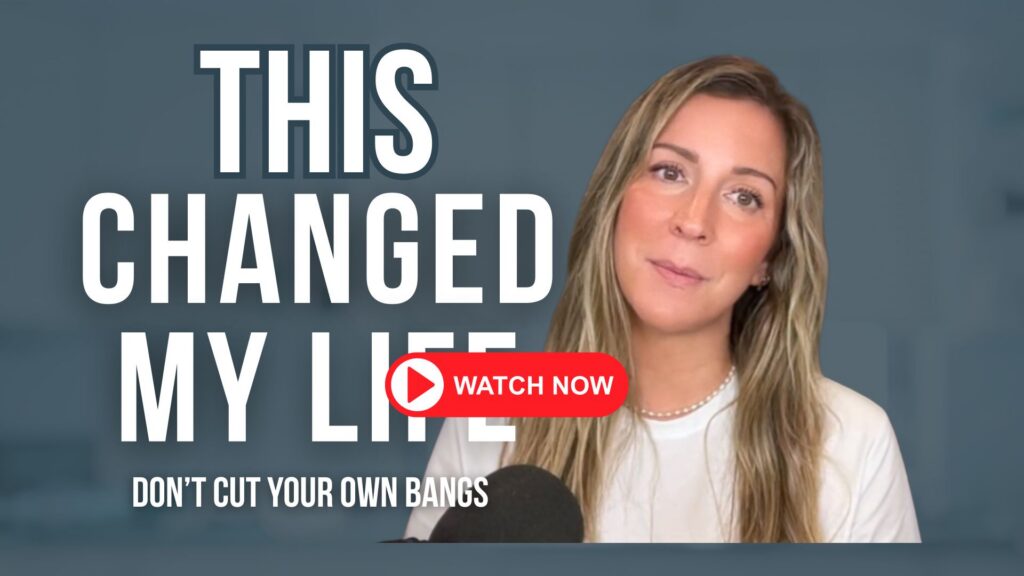
Confidence Doesn’t Come From Perfect Answers (It Starts With Better Questions)
March 16, 2026
SUBSCRIBE ON YOUTUBE
This podcast is the remedy to comparison and feeling like everyone has life figured out but you. I sit with experts, entrepreneurs and fellow creatives to explore the process of living a live we love. Including, the stumbles and mistakes that happen along the way.
Confidence is often treated like something we’re supposed to have before we take action. Before we speak up.Before we make a decision.Before we trust ourselves. But in reality, confidence rarely shows up first. More often, confidence grows after we pause long enough to ask better questions. In this solo episode of Don’t Cut Your Own […]
Confidence is often treated like something we’re supposed to have before we take action.
Before we speak up. Before we make a decision. Before we trust ourselves.
But in reality, confidence rarely shows up first.
More often, confidence grows after we pause long enough to ask better questions.
In this solo episode of Don’t Cut Your Own Bangs, I share a story from my early career as a ballroom dance instructor that unexpectedly revealed something important about confidence — and eventually led me to become a therapist.
It also inspired a simple practice I still return to when life feels overwhelming: clarity with 7 simple questions that help you reconnect with yourself and move forward with greater confidence.
But first, let’s go back to the dance studio.
Confidence grows when we ask better questions. Discover clarity with 7 simple questions that help you trust yourself and move forward.
The Moment I Saw Confidence Slip Away
Years ago, I was standing in a ballroom dance studio counting out loud:
“5, 6, 7, 8.”
Michael Bublé was playing in the background while I was teaching a couple their first dance for their wedding.
The bride was wearing satin ivory heels to match her wedding dress. They were beautiful, but slightly higher than what she was used to wearing.
Every time she stepped backward into the foxtrot, I could see something shifting.
Her shoulders tightened.
Her movements became smaller.
Her confidence was slipping.
She wanted to feel graceful and beautiful on her wedding day, but in that moment she felt awkward and unsure.
Her partner kept asking if he was doing something wrong.
She reassured him:
“No, no. It’s not you. It’s me.”
Two people trying their best.
But something deeper was happening.
The more we focused on fixing the dance steps, the more obvious it became that the problem wasn’t the dance.
So we stopped.
And I asked her a different question:
“How do you want to feel when you walk onto the dance floor?”
Her eyes filled with tears.
“I want to feel like I belong there.”
That moment changed something in me.
Because what I realized in that room had very little to do with choreography and everything to do with confidence and emotional understanding.
What Is Confidence?
Confidence is often misunderstood.
Many people think confidence means certainty — knowing exactly what to do and feeling completely sure about it.
But that’s not how confidence actually works.
Confidence is the willingness to move forward without having perfect answers.
Confidence grows through experience, curiosity, and reflection. It develops when we learn how to listen to ourselves rather than waiting for external validation.
And one of the most powerful ways to build confidence is through better questions.
Why Better Questions Build Confidence
Looking back now, many of the biggest turning points in my life didn’t come from having the perfect plan.
They came from asking a better question.
The right questions can interrupt the spiral of overthinking and slow the nervous system, creating space for clarity.
Instead of forcing immediate solutions, questions invite curiosity — and curiosity often leads to confidence.
That’s where the practice of clarity with 7 simple questions comes in.
Clarity With 7 Simple Questions
When life feels overwhelming or unclear, these questions can gently guide you back to yourself.
They’re simple, but surprisingly powerful.
1. Where can I be more honest right now?
Sometimes stress grows because we’re avoiding what we already know to be true.
Honesty creates alignment — and alignment builds confidence.
2. What am I avoiding?
Avoidance is often a signal pointing toward something important.
Turning toward it, even briefly, can bring unexpected clarity.
3. Where am I holding tension?
Your body holds information your mind hasn’t processed yet.
Tight shoulders, shallow breathing, or jaw tension can signal where your attention is needed.
4. If I were more gentle here, what could change?
Many of us default to criticism when we feel uncertain.
Gentleness creates the psychological safety needed for clarity and confidence to emerge.
5. HALT: Am I Hungry, Angry, Lonely, or Tired?
This acronym is simple but incredibly effective (and borrowed from AA).
Sometimes what feels like a complicated emotional problem is actually a basic need asking for attention.
6. Who am I jealous of right now?
Jealousy can be uncomfortable, but it often reveals something meaningful.
Instead of judging the feeling, ask what it might be pointing toward in your own life.
7. Sweet or savory?
This may sound small, but even simple decisions restore momentum.
Confidence often grows through small choices and forward movement, not big dramatic leaps.
What Confidence Actually Feels Like
Confidence doesn’t always look bold or fearless.
Sometimes confidence looks like:
• asking a thoughtful question • taking the next small step • admitting you’re unsure • trusting yourself to figure things out
In the dance studio, confidence didn’t appear when the bride perfected her steps.
It appeared when she allowed herself to imagine how she wanted to feel.
That emotional clarity changed everything.
Everyday Moments Where Confidence Grows
A Work Decision
You hesitate to share an idea in a meeting.
Instead of asking, “What if I’m wrong?” you ask:
“What do I want my voice to contribute here?”
Confidence grows from participation.
A Relationship Conversation
You’re avoiding a difficult conversation.
Instead of rehearsing the perfect script, you ask:
“Where can I be more honest?”
Clarity replaces tension.
An Overwhelming Day
Everything feels like too much.
You pause and ask:
“Am I hungry, angry, lonely, or tired?”
Meeting your needs restores perspective.
Confidence Comes From Trusting Yourself
Confidence doesn’t arrive all at once.
It grows through repeated moments of curiosity and self-trust.
Every time you pause to ask a better question, you strengthen that relationship with yourself.
And over time, that relationship becomes the foundation of confidence.
Key Takeaways
• Confidence grows through curiosity, not perfection • Asking better questions creates clarity during overwhelming moments • Practicing clarity with 7 simple questions helps reconnect you with your inner guidance • Confidence develops when you trust yourself to take the next step
A Final Encouragement
If confidence feels far away right now, that’s okay.
You don’t need to solve everything today.
Sometimes the most powerful thing you can do is pause long enough to ask the next right question.
And then take the next right step.
If this reflection resonated with you, consider subscribing to the podcast, leaving a review, or sharing this with a friend who might need it today.
Your support helps more people find these conversations.
And until next time—
Take good care of yourself.
And remember: Don’t cut your own bangs.
RATE, REVIEW, SUBSCRIBE TO “DON’T CUT YOUR OWN BANGS”
Like your favorite recipe or song, the best things in life are shared. When you rate, review, and subscribe to this podcast, your engagement helps me connect with other listeners just like you. Plus, subscriptions just make life easier for everybody. It’s one less thing for you to think about and you can easily keep up to date on everything that’s new. So, please rate, review, and subscribe today.
I greatly appreciate your support and engagement as part of the Don’t Cut Your Own Bangs community. Feel free to reach out with questions, comments, or anything you’d like to share. You can connect with me at any of the links below.
[00:00:00] Speaker: I am standing in a ballroom dance studio counting out loud 5, 6, 7, 8, while Michael Buble is playing on repeat in the background, and I am working with a couple who are preparing for their first dance for their wedding. Their names have now escaped me, but their faces will probably be imprinted in my mind forever.
[00:00:20] The bride to be is wearing these satin ivory heels to match her wedding dress. The heels are just a little higher than she’s comfortable wearing, and every time she takes a step backwards to learn the foxtrot, I can see her confidence slipping.
[00:00:35] She wants to feel like a princess on her big day, but right now she feels awkward. She feels off balance and maybe a little embarrassed. Her partner is trying to help, but he doesn’t really know how. And technically this was supposed to be a 30 minute introductory dance lesson provided by yours truly.
[00:00:56] The kind where you get the couple excited about dancing and then they sign up for more lessons and they think, Hey, after the wedding, this should be a hobby. It was meant to be a little razzle dazzle, not borderline crisis. My job was to be teaching them steps to the foxtrot while dancing to Michael Boole, and what ended up happening that day had a lot less to do with counting steps.
[00:01:17] And a lot more to do with helping someone see themselves in a new way. Believe that they could walk into the most important day of their life, feeling confident and supported, believing in themselves,
[00:01:30] and standing there in that dance studio. I started to get the early whispers, that there was something more interesting happening in that room and with me that wasn’t about dancing. It was happening inside the people that I was working with,
[00:01:46] that moment and several like it turned out to be the beginning of a question that would eventually change my entire career in the trajectory of my life. Hello, hello, and welcome to Don’t Cut Your Own Bangs. I am Daniel Ireland and I am really glad you’re here. If you’re new to the podcast, the heart of this show is an attempt at asking and answering a simple question,
[00:02:09] how do we turn our emotions into allies? Instead of treating them like obstacles, how do we listen to discomfort, curiosity, excitement or fear, and use those signals to help guide us to our next step forward? Instead of feeling stuck or like we’re failing because emotions aren’t problems, they’re information.
[00:02:30] One of the most powerful ways that we learn how to understand that information is through stories.
[00:02:36] So today I wanna share a little bit more about my own story, how I went from being a ballroom dance instructor to becoming a therapist who runs her own practice. And later in this episode, I’m also going to share seven simple steps that I come back to when I’m feeling overwhelmed or unclear. But first, let’s go back to the dance studio.
[00:02:57] I remember watching this bride she would step back. She would step to the side, and every time she would step back in her heels, her shoulders just began to tighten a little bit more. She was counting the steps out loud, which is not something a bride wants in her wedding photography.
[00:03:12] And her partner kept asking and assuming he was doing something wrong, and she would say, no, no. It’s, it’s not you. It’s me. And.
[00:03:20] Whenever the tension builds in a moment like that, it is so quick, and as it often does, someone wants to find fault or blame because if there’s blame, then someone can take responsibility and make it better. This was one of those uncomfortable life moments where. Two people were genuinely trying their best.
[00:03:40] Nobody was doing anything wrong nor was the bride doing anything wrong in how she was learning. What was happening deeper below the surface is what she was feeling, and in response to that, what her partner was feeling.
[00:03:52] The first attempt is to try to correct the steps. You know, try to keep your frame tight about where you’re placing your weight and how you’re stepping. But the more we kept focusing on the dance, the more obvious it became that what was happening with these two had nothing to do with the dance or their ability to dance.
[00:04:07] So we stopped. The music kept playing though. God, Michael Bule played a lot back in those days, at least in my teaching days. And I don’t remember again exactly what I said, but I know that there was a moment of reframe where it essentially was. Let’s step out let’s just forget about the steps and tell me about what you wanna feel when you walk onto the dance floor to do your first dance at your wedding.
[00:04:30] And. I remember her saying, I wanna feel like I belong there. Not like I’m just doing the thing you’re supposed to do at your wedding. I wanna feel beautiful. And she started to get teary eyed at that, which of course whenever I see someone cry, I feel like I’m about to start to cry as well. And. I really settled into a zone and realized that there was this really interesting part of my job that had nothing to do with choreography, but there was emotional work happening
[00:04:58] and at the time, I didn’t know. I couldn’t know where that curiosity was going to lead me, but
[00:05:04] I just knew or started to know that I was more interested in understanding these people than I was perfecting their steps. And eventually that curiosity led me to graduate school where I became a therapist.
[00:05:17] Before I keep going, I wanna take just a quick break, a quick moment to share two things that actually grew directly out of the work I do both here on the podcast and with my therapy clients. The first is the Treasure Journal. It’s a guided journal in seven parts that I created for people who wanted a place to slow down and listen to their thoughts, listen to their emotions, instead of just trying to power through them, but felt intimidated by or frozen when they faced a blank page.
[00:05:44] It’s filled with sentence stems, quotes. It’s helps you find a place to put your feelings in a way that feels constructive. The second is my children’s book. Wrestling a walrus for little people with big feelings, which helps kids understand big emotions in a playful way that reminds them that frustration and overwhelm are a part of learning, not signs that something’s wrong.
[00:06:03] If either of those sound helpful to you. They are both linked in the show notes for your convenience. Okay, now back to the conversation.
[00:06:10] Looking back now, I can see that many of the moments in my life where things were changing direction didn’t come from having a perfect answer or a perfect solution. They came from asking a better question. So here are seven simple check-in questions that I’ve come back to many, many times when things feel overwhelming. And I just wanna give a quick shout out to Ashlyn Thompson for asking me for simple questions in our podcast interview, which is what inspired this one.
[00:06:37] As I go through the questions, you might notice that many of them were quietly present in the dance studio moment.
[00:06:44] Where can I be more honest right now? What am I avoiding? Where am I holding tension? If I were more gentle here, what could change? Halt. Am I hungry, angry, lonely, or tired? It’s one of my favorite acronyms. Got from aa. Who am I jealous of right now, and what might that be telling me about something I want to create.
[00:07:07] Sweet or savory, sometimes clarity actually starts with a small choice. So now I want to invite you to connect these questions with your own life. One of the things most I love about this podcast is that it is becoming a conversation. If there is something you’ve heard me mention in passing that you wanna hear more about an anecdote, a tangent, a a short story or something I say, I’ll elaborate on.
[00:07:33] Tell me, a mental health topic or even a guest you would love to hear from or hear from again, because this community is becoming something that we are building together,
[00:07:42] sometimes, not as often as I used to, but many times I think back to that couple at the dance studio, the bride sat in shoes, the Michael Buble playing on repeat, the nervous laughter, and the moment that somebody realizes that. They can trust themselves to figure it out. They can trust themselves to take a next step.
[00:08:02] That is also what a really good question can do. The right question placed at the right time to unlock new information. They don’t always give us an answer. Take that job, leave that relationship, but they can help us trust ourselves enough to move forward to the next right inch, the next right millisecond.
[00:08:22] And that more than anything is the heart of this podcast, learning how to turn our emotions into allies instead of obstacles. Thank you for being here. Your time, your attention, they mean the world to me. And until next time. Take good care of yourselves.
[00:08:36] And remember, don’t cut your own bangs.
Join my email list to get access to tools + resources to help improve your mental health. Plus, be the first to know about new episodes, blogs and more.
Get actionable advice + mental health tips in your inbox.