

Emotional volatility can feel confusing, especially when anger seems to come out of nowhere. One minute you are holding it together, and the next your chest is tight, your jaw is clenched, and you are replaying a conversation on a loop. It can make you wonder whether you are too sensitive, too reactive, or just bad at handling your emotions.
But emotional volatility is not always the same thing as instability. Sometimes it is what happens when your system has been trying to get your attention for a while, and you have been too busy, too practiced at minimizing, or too committed to keeping the peace to notice it sooner.
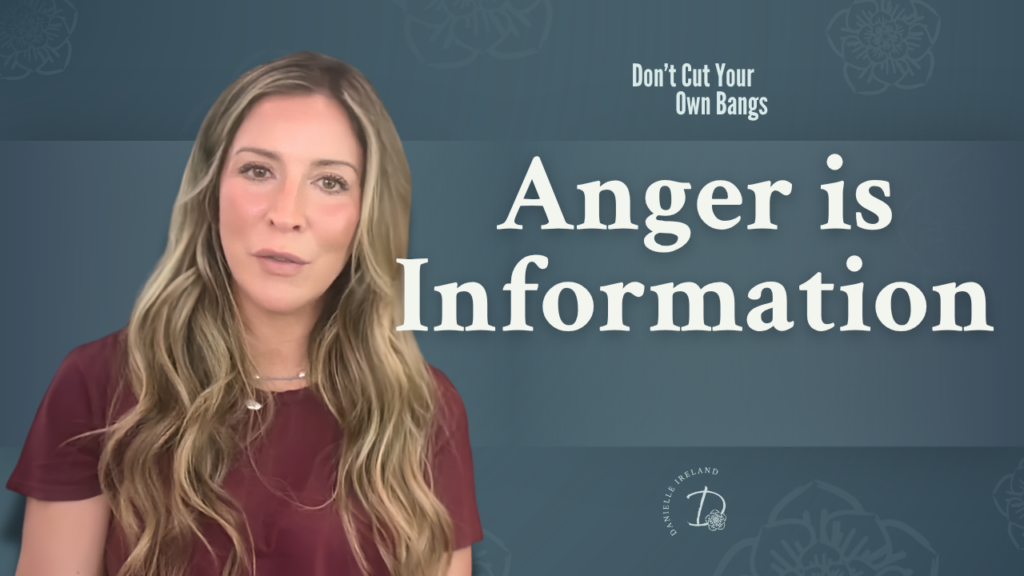
In this solo episode of Don’t Cut Your Own Bangs, I share a therapist-informed look at understanding anger—what it actually is, why it often shows up later than you think it should, and how to listen to it without letting it drive the car.
What is emotional volatility?
Emotional volatility is the experience of emotions feeling fast, intense, unpredictable, or hard to contain.
It can look like:
- feeling fine until something small suddenly tips you over
- getting disproportionately angry and then judging yourself for it
- swinging between shutting down, overexplaining, and wanting to explode
What matters here is that emotional volatility is not just about “big feelings.” It is often about unprocessed feelings, layered stress, and a nervous system that has had to absorb too much for too long.
What does understanding anger actually mean?
Understanding anger means treating it like information instead of proof that something is wrong with you.
Anger often says:
- a boundary was crossed
- something felt unfair
- you were dismissed, betrayed, overlooked, or overpowered
- you need something you have not fully named yet
- or, fear
Anger is not always elegant. It is not always convenient. But it is often clarifying.
That does not mean every angry reaction is correct or that every story anger tells is fully accurate. It means anger deserves interpretation, not immediate dismissal.
Why emotional volatility and anger often go together
This is one of the most important pieces.
Most people do not go from calm to furious for no reason. More often, anger builds quietly under layers of over-tolerance, people-pleasing, self-doubt, or chronic emotional override.
This might look like:
- laughing something off in the moment, then raging about it in the car
- telling yourself “it’s not a big deal” while your body says otherwise
- needing three conversations with three different people before you can admit that yes, actually, that bothered you
That is not drama. That is delayed recognition.
When you are skilled at managing everyone else’s feelings, your own anger may be one of the last emotions you allow yourself to fully hear.
Anger can protect you—or mislead you
One of the strongest parts of this week’s podcast is the distinction between anger that protects and anger that disconnects. I share a personal example of a relationship where anger knew something before I was ready to know it. The rage came after the original shock, and it helped me recognize a BIG line had been crossed. That anger got me out.
That is protective anger.
But I also talk about the other side: when anger gets tangled up in righteousness, ego, or the need to be right. That kind of anger narrows my vision. It takes away curiosity. It can give me permission to be unkind if I’m not in touch with my feelings. And later, it usually leaves a residue of regret.
Listen to your anger and treating it like information makes all the difference, especially when it comes to boundaries and healthy communication.
Signs your anger may be asking for attention
If you are trying to understand anger in real life, here are a few signs it may be building:
- you keep replaying the same interaction
- you are telling the same story repeatedly and the feelings feel fresh every time
- you feel irritated by things that normally would not get to you
- you are managing everyone else’s emotions and feel secretly resentful
- your body feels activated even when you are saying “I’m fine”
Sometimes anger shows up as exhaustion, sarcasm, or withdrawal before it ever looks like obvious rage.
How to work with anger without pushing it down or blowing everything up
This is where the episode gets especially useful.
Instead of asking, “Why am I like this?” try asking:
- What about that actually bothered me?
- What do I need right now?
- If my anger could speak clearly without blowing everything up, what would it say?
Those questions are simple, but they are powerful.
Here is what this might look like in real life:
You leave a conversation and feel weirdly activated. Instead of immediately texting a friend for validation, you pause and ask, “What bothered me?” Maybe the answer is, “I felt dismissed.”
You are snappy with your kids or partner and tempted to tell yourself you are just tired. Maybe you are. But maybe you are also angry because you have been carrying too much and no one seems to notice.
You keep saying yes when you want to say no, and then you resent everyone around you. That resentment may not be the whole story, but it is probably pointing toward a boundary you need to get clearer about.
Understanding anger starts with slowing down
Reacting to anger is fast. Listening to anger is s l o w e r.
That slower process is where self-trust grows.
You do not have to fix everything in the first moment. You do not have to decide immediately whether your anger is justified or whether you need to act on it right away. Sometimes the most important step is just naming what feels true.
Emotional volatility does not mean you are broken
If anger feels big, fast, or hard to contain, that doesn’t mean you’re too much.
It may mean your system is overloaded.
It may mean something mattered, and you felt disappointed.
It may mean you have been listening to everyone else for so long that your own internal voice had to get louder to get your attention.
Emotional volatility starts to become less frightening when you stop treating big feelings like a threat.
Final thoughts on emotional volatility and understanding anger
Understanding anger begins when you stop asking, “How do I get rid of this?” and start asking, “What is this trying to show me?”
Anger is not always the enemy. Sometimes it is the most honest thing in the room.
Key takeaways:
- emotional volatility often points to overwhelm, delayed recognition, or unprocessed boundaries
- understanding anger starts by treating it as information, not failure
- anger can protect you, but it can also mislead you when it gets tangled in ego or control
- learning to listen to anger helps you build clarity, self-trust, and stronger boundaries
👉 If this resonated, subscribe to the podcast and share it with someone who is learning to listen to their emotions instead of fighting them.
RATE, REVIEW, SUBSCRIBE TO “DON’T CUT YOUR OWN BANGS”
Like your favorite recipe or song, the best things in life are shared. When you rate, review, and subscribe to this podcast, your engagement helps me connect with other listeners just like you. Plus, subscriptions just make life easier for everybody. It’s one less thing for you to think about and you can easily keep up to date on everything that’s new. So, please rate, review, and subscribe today.
DANIELLE IRELAND, LCSW
I greatly appreciate your support and engagement as part of the Don’t Cut Your Own Bangs community. Feel free to reach out with questions, comments, or anything you’d like to share. You can connect with me at any of the links below.
CONNECT WITH DANIELLE
- Follow me on: Instagram
- Check out: The Treasured Journal
- Buy my children’s book: Wrestling a Walrus
- Download: Free Essential Meditations audio series