

There’s a version of boundaries we don’t talk about enough.
Not the empowering kind.
Not the “protect your peace” Instagram graphic kind (which I’m sure I’ve posted plenty of times).
I mean the kind that started as protection…
and slowly became emotional armor.
The kind that once genuinely helped you survive something painful, overwhelming, disappointing, or emotionally unsafe.
But now?
Now they might be keeping connection out just as effectively as they’re keeping pain out.
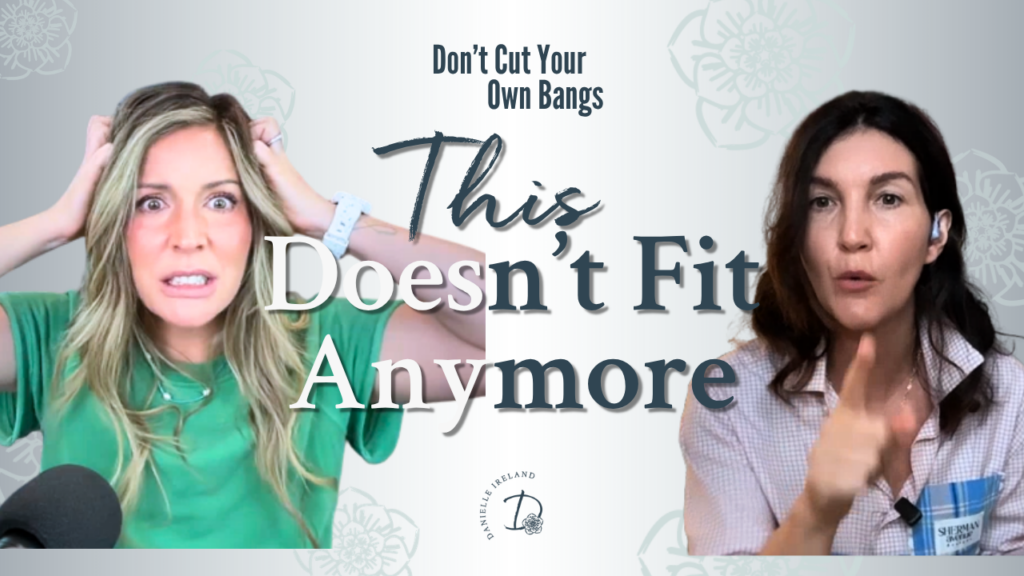
In this episode of Don’t Cut Your Own Bangs, I sat down with Teresa Sabatine from Love Lizzy for one of those conversations that quietly sneaks up on you. We talked about relationships, grief, self-protection, identity shifts, and the strange experience of realizing that something which once helped you survive might not actually fit who you’re becoming anymore.
And honestly?
I couldn’t help but wonder how many of us are carrying around emotional armor and calling it “boundaries.”
What Happens When Boundaries Stop Being Flexible?
Healthy boundaries usually create clarity.
They help you feel:
- grounded
- safe
- emotionally honest
- connected to yourself
But emotional armor feels different.
Armor is rigid.
Protective.
Heavy.
And the tricky thing is: it often develops for really understandable reasons.
After heartbreak.
After betrayal.
After constantly being the emotionally responsible one.
After years of feeling misunderstood.
After getting hurt when you finally let someone in.
This is why I loved something Teresa and I kept circling back to in the conversation:
sometimes the things that protected you in one season quietly become the things limiting you in the next.
The “Old Jacket” Problem
At one point in the episode, we landed on this metaphor that hasn’t left me.
What if the thing you call a boundary is actually an old form of protection that doesn’t quite fit anymore?
Because some boundaries are like old jackets.
You needed them once.
They got you through difficult weather.
You wore them constantly because they helped you feel safe.
But eventually?
They start feeling heavy.
Restrictive.
Outdated.
And somehow they’re still hanging in the closet (organizing your whole life around them).
That doesn’t mean the jacket was bad.
It means you changed. Evolved. Out grew it.
I think this happens emotionally all the time.
Examples of Emotional Armor Disguised as Boundaries
This might look like:
- deciding you “just don’t need to go out anymore”
- refusing help because relying on others once felt unsafe
- keeping every relationship surface-level (talking about the weather)
- avoiding difficult conversations while calling it “protecting your peace”
- convincing yourself you’re low maintenance when you’re actually terrified of needing anything
And listen…
none of this makes you broken.
It makes you adaptive.
A lot of high-functioning people become incredibly good at turning survival strategies into personality traits.
Especially women.
Especially thoughtful, emotionally aware women who are used to being “the strong one.”
Why Healing Shame Changes Your Relationships
One thing I see constantly as a therapist is how often shame disguises itself as self-protection.
Because shame says:
Don’t be too much.
Don’t need too much.
Don’t ask for reassurance.
Don’t let people see the messy parts.
Don’t risk rejection.
So instead of vulnerability, we choose control.
Distance.
Performance.
Independence.
Perfection.
And over time, emotional armor starts feeling safer than connection.
But safer and healthier are not always the same thing.
What Healthy Boundaries Actually Feel Like
Healthy boundaries don’t usually shrink your life.
They support it.
They make room for:
- honesty
- flexibility
- repair
- intimacy
- self-respect
- emotional safety that isn’t built entirely around avoidance
And importantly: healthy boundaries can evolve.
Because not every protective strategy is meant to become a permanent identity.
Sometimes growth looks less like “letting people in” and more like gently asking yourself:
Does this still fit who I’m becoming?
A Small Question Worth Sitting With
Instead of asking:
“Am I too guarded?”
Try asking:
“What is this protecting me from?”
That question changes everything.
Because underneath many rigid boundaries is often:
grief,
fear,
shame,
disappointment,
or the fear of not being enough.
And honestly?
Sometimes naming that is the first real moment of connection we’ve had with ourselves in a while.
Final Thoughts
If this resonated, I hope you hear this clearly:
Outgrowing old protection doesn’t mean you were wrong for needing it.
It just means you’re changing.
And maybe healing isn’t about becoming boundaryless.
Maybe it’s about noticing which forms of protection still support your life…
and which ones quietly keep you emotionally armored.
Key Takeaways
- Boundaries can slowly become emotional armor when they stop evolving
- Emotional self-protection often develops from grief, shame, or past hurt
- Healthy boundaries create clarity and connection—not just distance
- Growth sometimes means recognizing when old protection no longer fits
👉 If this episode resonates, share it with a friend who might also need this reminder. And don’t forget to subscribe so new episodes find you—no chasing required.
RATE, REVIEW, SUBSCRIBE TO “DON’T CUT YOUR OWN BANGS”
Like your favorite recipe or song, the best things in life are shared. When you rate, review, and subscribe to this podcast, your engagement helps me connect with other listeners just like you. Plus, subscriptions just make life easier for everybody. It’s one less thing for you to think about and you can easily keep up to date on everything that’s new. So, please rate, review, and subscribe today.
DANIELLE IRELAND, LCSW
I greatly appreciate your support and engagement as part of the Don’t Cut Your Own Bangs community. Feel free to reach out with questions, comments, or anything you’d like to share. You can connect with me at any of the links below.
CONNECT WITH TERESA
CONNECT WITH DANIELLE
- Follow me on: Instagram
- Check out: The Treasured Journal
- Buy my children’s book: Wrestling a Walrus
- Download: Free Essential Meditations audio series