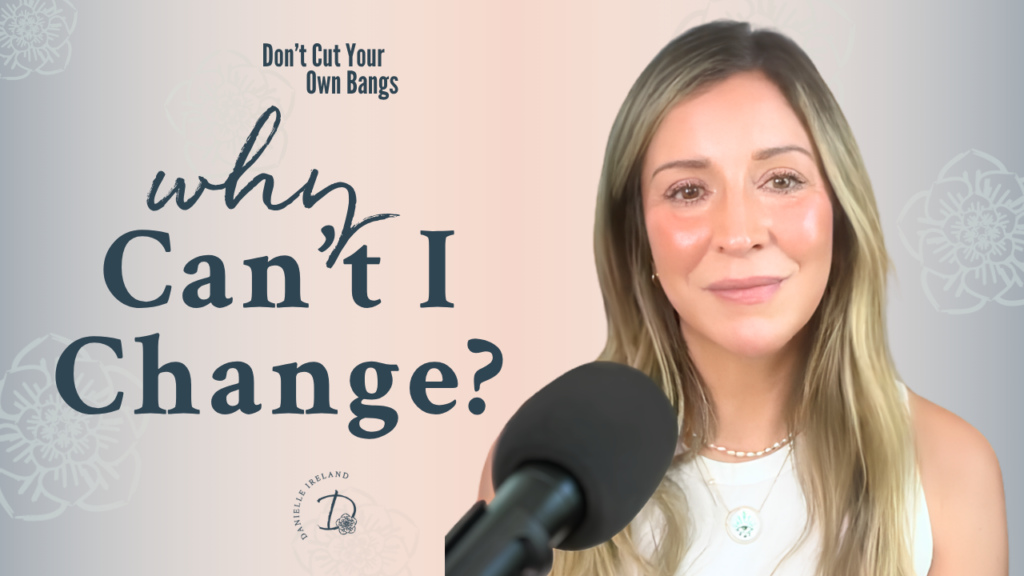
This podcast is the remedy to comparison and feeling like everyone has life figured out but you. I sit with experts, entrepreneurs and fellow creatives to explore the process of living a live we love. Including, the stumbles and mistakes that happen along the way.
If You Need to Hear This Today… Knowing better and being able to do something differently in the moment are not the same thing. You can understand the pattern. You can know where it came from. You can recognize exactly how it’s affecting you. You can even know what you’d rather do. And then Tuesday […]
If You Need to Hear This Today…
Knowing better and being able to do something differently in the moment are not the same thing.
You can understand the pattern.
You can know where it came from.
You can recognize exactly how it’s affecting you.
You can even know what you’d rather do.
And then Tuesday afternoon rolls around and—there you are.
Doing the thing again.
Maybe you said yes when you wanted to say no.
Maybe you took care of everyone else before realizing you hadn’t eaten lunch.
Maybe you promised yourself you were finally going to have that conversation, and then the moment arrived and you thought, Actually, perhaps I will reorganize this drawer instead.
And that can be incredibly frustrating because once we become aware of something, we tend to expect ourselves to immediately know how to change it.
I know better. Why am I still doing this?
But what if repeating an old pattern isn’t evidence that you can’t change?
What if you’re asking yourself to radically change direction without accounting for all the time, history, relationships, and repetition that helped carry you to where you are now?
Maybe change doesn’t begin by overhauling your life.
Maybe it begins by pumping the brakes.
Why is it so hard to change a pattern once you recognize it? Learn why awareness counts, old patterns take time to change, and how one small shift can build self-trust.
Why Is It So Hard to Change When I Know Better?
I see this often in therapy.
Someone has an enormous realization and almost immediately dismisses it because nothing visible has changed yet.
They recognize their resentment may be pointing toward an unmet need.
They finally see a relationship pattern they’ve been repeating.
They realize their exhaustion isn’t just a busy week—it’s connected to how much responsibility they’ve been carrying.
And then comes:
Okay. How do I stop doing this?
Followed shortly by:
Why am I STILL doing this? I know better.
The insight becomes another expectation.
The problem is that knowing something intellectually and having enough practice for a different response to become available in real time are two very different things.
If information alone changed behavior, the self-help section of the bookstore would be considerably smaller.
We’d read one book, nod thoughtfully, close the cover and say, “Excellent. I will never struggle with that again.”
Unfortunately, most of us have not found that book.
Because patterns aren’t built from information alone.
They’re practiced.
They’re reinforced.
They’re often woven into relationships and roles that matter deeply to us.
Some of them helped us feel connected, appreciated, useful, successful, needed, or loved.
So when you have a breakthrough about something you’ve been practicing for 10, 20, or 30 years, it’s probably unfair to expect your brain to respond:
Wonderful. Updating operating system now.
Recognition matters.
But recognition is the beginning of change—not evidence that the change should already be complete.
What Does a Moving Train Have to Do With Burnout?
Imagine an old, heavy locomotive traveling at full speed down a track.
It has momentum.
The track is smooth because the train has traveled it again and again.
Now imagine deciding, in one instant:
I don’t want to go this way anymore.
You wouldn’t expect the train to immediately make a sharp left.
And you certainly wouldn’t want to derail it just to prove you were serious about changing directions.
You would start applying the brakes.
Squeeze.
Release.
Squeeze.
Release.
Over time, the train begins to slow.
I love this metaphor because so many of the patterns connected to burnout and carrying too much have momentum behind them.
Maybe you’ve spent years:
Putting other people’s needs first.
Trying not to inconvenience anyone.
Being the dependable one.
Avoiding disappointing people.
Keeping the peace.
Saying, “It’s fine, I’ve got it.”
And maybe some of those behaviors have been rewarded.
People appreciate you.
They rely on you.
You feel useful.
You avoid conflict.
You get the emotional equivalent of a gold star.
Even when the pattern itself slowly stops working for you, there may still be something familiar—and rewarding—about traveling that track.
So when you finally recognize, I don’t want to keep doing this, awareness itself is one of the first pumps of the brakes.
You’re slowing the momentum enough to eventually ask:
Where do I actually want to go?
Awareness Doesn’t Need to Become an Assignment
This might be the reframe I want you to hold onto most:
Awareness doesn’t need to immediately become an assignment.
We high-functioning types can be remarkably efficient at turning self-awareness into homework.
Oh, I have an unmet need? Great. New routine.
Boundary issue? Excellent. I will resolve every relationship dynamic by Thursday.
Burnout? Let me buy a new planner.
We take something tender that we’ve just recognized and immediately put it on a performance improvement plan.
But there is value in simply being honest about where you are.
Think about using a GPS.
Before it can give you useful directions, it needs two pieces of information:
Where are you?
And where are you trying to go?
If it can’t locate your starting point, the directions aren’t particularly useful.
Your emotional life is obviously more complicated than Google Maps, but the principle is helpful.
Before you can make a meaningful change, you need to be able to sit with where you actually are—with some clarity, context, compassion, and preferably a little less judgment.
You don’t need to punish yourself into a new direction.
You need an accurate starting point.
Why Do I Keep Falling Back Into Old Patterns?
Because familiar can feel safer than unfamiliar—even when familiar isn’t particularly comfortable.
When life gets stressful, relationships feel turbulent, or you’re emotionally overloaded, you’re more likely to reach for the responses you’ve practiced most.
That doesn’t necessarily mean those responses are good for you.
It means they’re available.
Think about driving home.
You can travel the same route so many times that eventually you barely think about each turn.
Then one day you decide to stop somewhere different on the way home—and halfway there, you realize you accidentally took your normal exit.
Your brain followed the well-traveled route.
Emotional patterns can operate similarly.
If you’ve had decades of practice accommodating other people before checking in with yourself, you will probably still do that sometimes after realizing you want to change.
If you’ve spent years avoiding difficult conversations, recognizing the pattern won’t necessarily make your body feel comfortable the first time you speak up.
If being useful has been one of your most reliable pathways to connection, centering your own needs may initially feel strange.
That isn’t proof that the new direction is wrong.
It may simply mean you have more practice hours behind the wheel of the old one.
And that’s why I like remembering something when I’m impatient with change:
We often overestimate what we can change in a week and underestimate what can change in a year.
A year gives you room to practice.
What Happens When You Don’t Know What You Want?
There’s another piece of this that doesn’t get talked about enough.
Before you can begin moving toward what you want, eventually you have to ask:
What do I want?
For people who are exceptionally practiced at being useful, this can be a surprisingly difficult question.
I know what everyone else needs.
I know what would make things easier.
I know what needs to happen next.
I know the soccer schedule, the work deadline, what we’re out of at the grocery store and, for reasons I cannot explain, the exact cooking instructions on the box of macaroni and cheese.
But what do I want?
Blank.
I remember experiencing this firsthand when I was four months postpartum and working with my friend and coach LaShell Wooten.
I was exhausted and newly returning to work, and when I thought about what might help, I was asking for scraps.
Thirty more minutes of sleep.
Maybe a little more help here.
Maybe if this one small thing changed.
LaShelle listened and then asked me to describe my ideal morning.
Not a realistic morning.
Not what I could reasonably accomplish with childcare and work and all the other logistics.
My ideal morning.
And I remember how difficult that felt.
Because I had become so disconnected from play, adventure, wonder, pleasure, and desire that simply imagining what I wanted felt unfamiliar.
What If What I Want Isn’t Realistic?
Good.
For a couple of minutes, let it be unrealistic.
The purpose of imagining your ideal day isn’t to immediately make it happen.
You don’t need a babysitter.
You don’t need a budget.
Nobody needs to approve your PTO.
There is no feasibility study.
You’re simply practicing access to your own desire.
Ask:
What would I do?
Where would I go?
What would I wear?
How would I feel?
What would be nice?
Maybe you discover you want more quiet.
Maybe you want to play.
Maybe you want to be outside.
Maybe you want a slower morning.
Maybe you want to eat breakfast without standing over the kitchen counter while simultaneously packing someone else’s lunch.
You do not have to do anything with the answer.
The point is not execution. The point is access.
Because before you can build a life that includes you, you may have to remember what you like.
And something interesting may happen once you do.
You savor your coffee a little longer.
You play with your kids differently.
You give yourself five quiet minutes.
Tiny pieces of what you imagined begin finding their way into the life you already have.
Not because you completed a seven-step transformation plan.
Because you remembered yourself.
How Do I Actually Start Changing an Old Pattern?
Make it smaller.
Much smaller.
Instead of:
How do I change my life?
Try three sentences:
I feel.
What is happening inside me?
Not what they did.
Not what your boss won’t do.
Not what everybody else should understand.
Come inward.
I feel tired.
I feel lonely.
I feel resentful.
I feel overwhelmed.
I feel disconnected.
I need.
What might that feeling be telling you?
I need rest.
I need help.
I need space.
I need connection.
I need quiet.
I need a transition.
I need to be heard.
I will.
What is one thing within your control that responds to what you just learned?
Not:
I will make everyone understand.
Not:
I will get them to change.
Not:
I will completely reorganize my life.
One degree.
Maybe:
I feel tired. I need rest. I will spend 15 minutes of my lunch break reading something purely for pleasure.
Does that solve exhaustion?
Of course not.
That’s not what we’re doing.
We’re pumping the brakes.
The important thing is:
I noticed myself, and I responded.
The Heart of This Conversation
Self-trust doesn’t grow because you suddenly become perfect at listening to yourself.
It grows every time you hear yourself and respond.
You don’t need to quit the job today.
Figure out the entire marriage.
Reorganize your family.
Develop flawless boundaries.
Stop feeling resentful forever.
There is time and history behind the person you are today.
There are reasons you learned to operate the way you do.
Understanding those reasons doesn’t mean you have to stay there.
It gives you the chance to start somewhere different without making yourself wrong for where you began.
And your answer may change five minutes of an otherwise completely ordinary Tuesday.
That counts.
Because every time you notice yourself, take your experience seriously, and make one small decision that includes you, you’re pumping the brakes on an old pattern.
One degree becomes another.
And another.
And maybe someday you look up and realize:
I’m headed somewhere different.
A Gentle Reflection
Think about one pattern you’ve been frustrated with yourself for repeating.
Not the biggest problem in your life.
Just one thing you already know.
Instead of asking:
Why am I still doing this?
Try:
I feel…
What is happening inside me?
I need…
What might that feeling be pointing toward?
I will…
What is one small thing within my control that responds to what I just learned?
Then stop.
You don’t have to make it bigger.
You’re not trying to derail the train.
You’re practicing one pump of the brakes.
FAQ
Why is it so hard to change even when I know better?
Because intellectually understanding a pattern and having enough practice to respond differently in real time are not the same thing. Familiar patterns often have years of repetition, relationships, and reinforcement behind them. Awareness is an important first step, but new responses need practice too.
Why do I keep repeating patterns I know aren’t good for me?
Old patterns may still provide something familiar or rewarding, such as approval, connection, conflict avoidance, usefulness, or predictability. Under stress, familiar responses can also become easier to access simply because you have practiced them more often.
How do I start changing an old pattern without overwhelming myself?
Start with one small response rather than an entire life overhaul. Try I feel → I need → I will: identify what you feel, ask what the feeling may be telling you that you need, and choose one action within your control.
What if I don’t know what I want?
Practice wanting before worrying about execution. Imagine an ideal morning or day without requiring it to be realistic. The purpose isn’t to immediately create that life; it’s to reconnect with your own preferences, pleasure, curiosity, and desire.
One Last Thing…
The goal of all of this is not to care less.
Your empathy isn’t the problem.
Your tenderness isn’t the problem.
Wanting to show up for people you love and love them well isn’t the problem.
I don’t want you to lose any of those things.
I want you to remember that you belong inside the circle of people you’re caring for.
You get to have feelings.
You get to have needs.
You get to want things.
You get to change your mind.
You can care about someone’s disappointment without automatically making their disappointment evidence that you did something wrong.
You can love people deeply without carrying every feeling they have.
And your needs don’t have to win every time—or make somebody else lose—but they deserve to be represented.
Especially by you.
This three-part series grew out of Supporting Others Without Losing Yourself, one of the conversations I love bringing to organizations, conferences, professional associations, women’s groups, and helping professionals as a speaker. The heart of the work is not teaching people how to become less caring. It’s helping people continue to care without disappearing from their own lives.
If you’re looking for a speaker to bring these conversations to your organization or conference, I’d love to continue the conversation there.
And if you want to hear the full Supporting Others Without Losing Yourself series, you can find it on Don’t Cut Your Own Bangs.
👉 If this episode resonates, share it with a friend who might also need this reminder. And don’t forget to subscribe so new episodes find you—no chasing required.
RATE, REVIEW, SUBSCRIBE TO “DON’T CUT YOUR OWN BANGS”
Like your favorite recipe or song, the best things in life are shared. When you rate, review, and subscribe to this podcast, your engagement helps me connect with other listeners just like you. Plus, subscriptions just make life easier for everybody. It’s one less thing for you to think about and you can easily keep up to date on everything that’s new. So, please rate, review, and subscribe today.
DANIELLE IRELAND, LCSW
I greatly appreciate your support and engagement as part of the Don’t Cut Your Own Bangs community. Feel free to reach out with questions, comments, or anything you’d like to share. You can connect with me at any of the links below.
Join my email list to get access to tools + resources to help improve your mental health. Plus, be the first to know about new episodes, blogs and more.
Get actionable advice + mental health tips in your inbox.