This podcast is the remedy to comparison and feeling like everyone has life figured out but you. I sit with experts, entrepreneurs and fellow creatives to explore the process of living a live we love. Including, the stumbles and mistakes that happen along the way.
If You Need to Hear This Today… Maybe you thought you’d be more certain by now. More established. More confident. Better at your job. Clearer about what you want. Less affected by what other people think. Maybe there’s a version of you that exists somewhere in your imagination who has finally figured herself out—and you […]
If You Need to Hear This Today…
Maybe you thought you’d be more certain by now.
More established.
More confident.
Better at your job. Clearer about what you want. Less affected by what other people think.
Maybe there’s a version of you that exists somewhere in your imagination who has finally figured herself out—and you keep quietly measuring the real you against her.
I should be further along.
I should know this by now.
I shouldn’t still struggle with this.
I should be better at this.
I should want this.
There’s nothing wrong with wanting to grow. But sometimes the pressure we feel to be “further along” has surprisingly little to do with where we actually want to go.
Sometimes we’ve been working very hard to meet a standard we never stopped to choose.
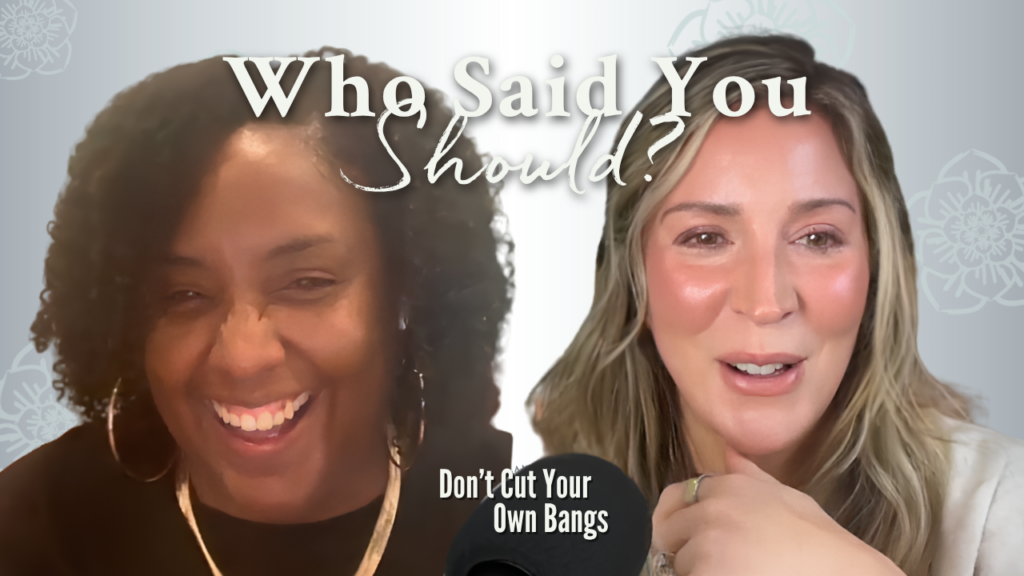
And there’s a question I haven’t been able to stop thinking about since a recent conversation with therapist and minister Rev. Hazel Owens:
Who said that?
Not why aren’t you there yet?
Not how can you get there faster?
Who said you were supposed to be there in the first place?
That question can change a lot.
The Quiet Weight of “I Should Be Further Along”
There is a particular kind of exhaustion that comes from constantly experiencing your life as slightly behind schedule.
You can accomplish something and immediately move the finish line.
You can become competent and focus on what you still don’t know.
You can receive an opportunity and wonder whether saying no means you aren’t ambitious enough.
You can build a life you genuinely like and still look sideways at someone else’s life and wonder whether you’re doing yours correctly.
The tricky thing about a “should” is that it often sounds like your own voice.
But sometimes it isn’t.
In my conversation with Hazel, she said that whenever she hears herself or one of her therapy clients say, “Well, I should be…”, she asks:
“To who? Who said that?”
Because, as she explained, the should is often attached to somebody else’s narrative rather than our own.
I stopped her.
Literally.
I told everyone listening to rewind the podcast because I thought it might be the key moment of our entire conversation.
I still do.
Because before we create another plan for becoming the person we think we should be, it might be worth asking who wrote the job description.
When Perfectionism Is Really About Belonging
Right before Hazel said those words, something clicked for me personally.
I told her that the little part of my personality that is always trying to be perfect may actually be trying to outrun or prevent abandonment.
If I do everything correctly…
If everyone likes me…
If I’m useful enough, thoughtful enough, successful enough, easy enough to be around…maybe nobody leaves.
Hazel connected that fear to something even bigger: the ways we can align ourselves with expectations that risk our own self-betrayal because we’re so afraid of not being chosen or being enough.
That one stings a little.
Because sometimes in trying desperately to prevent someone else from abandoning us, we abandon ourselves first.
We say yes when we mean no.
We keep proving something we no longer care about proving.
We choose what will look right rather than what feels aligned.
We perform a version of ourselves we think will be easiest to approve of.
And because all of that can look like achievement, responsibility, kindness, ambition, or being “good,” we may not recognize what it is costing us.
This is one reason I talk so often as a therapist and speaker about emotions as information.
The resentment, anxiety, dread, irritation, or heaviness we experience around something may not automatically mean the thing is wrong.
But it is information.
Something inside us is asking to be heard.
A Good Thing Can Still Be Wrong for You
Hazel has developed a question for opportunities, too:
Is this aligned with me?
She explained that when an opportunity isn’t aligned, she can feel herself begin to perform and pretend.
And then she said something wonderfully simple:
“Just because it’s a good thing doesn’t mean it’s my thing.”
That distinction matters.
A job can be good.
An invitation can be flattering.
A relationship can involve a perfectly lovely person.
An opportunity can make sense on paper.
Someone else can genuinely want something for you.
And it can still not be your thing.
One of the connections I made during our conversation was that the best things in my own life usually haven’t required a tremendous amount of internal persuasion.
When I am repeatedly trying to talk myself into something—or desperately trying to talk myself out of knowing what I already know—I’ve learned to get curious.
That doesn’t automatically mean “no.”
It means there’s information there.
You’re Allowed to Know Something Without Knowing Everything
This was actually where my conversation with Hazel began.
She is a licensed marriage and family therapist, minister, speaker, business owner, and clinical supervisor. She has accumulated years of education and experience.
And yet she described herself in a way I love:
“I am a student of the work that I am becoming an expert in.”
There is so much freedom in that sentence.
Because many of us secretly imagine growth as an arrival.
One day I’ll know enough.
One day I’ll be confident enough.
One day I’ll stop questioning myself.
One day I’ll finally feel like a real therapist, leader, parent, business owner, speaker, artist, grown-up—fill in your own blank.
And then I can relax.
But what if there is no final exam?
What if expertise isn’t the opposite of curiosity?
What if becoming good at something actually helps us appreciate the edges of what we know?
Hazel told me she never wants to feel as though she has fully arrived.
My immediate response was essentially:
Because then you’re done.
There is a difference between believing you know nothing and recognizing you don’t know everything.
The first erases your experience.
The second leaves room for growth.
What If You Let Yourself Fumble?
At one point Hazel told me she had recently discovered something about herself:
“I like fumbling.”
I loved the phrase immediately.
She likes getting her hands dirty. Trying something. Messing it up a little. Seeing whether she can figure it out before calling in reinforcements.
There’s playfulness in that.
And playfulness is something perfectionism rarely gives us.
Perfectionism tends to be very serious.
It wants to know the correct answer before raising its hand.
It wants to be naturally good at the thing it has never done before.
It wants assurance that the risk will pay off before taking it.
It would strongly prefer that nobody witness the fumbling.
But being a beginner asks something different of us.
Can I be bad at this long enough to learn something?
That is a question I’ve been experimenting with in my own life.
As a therapist and speaker, I spend a lot of time in spaces where I’m expected to know something. There is something unexpectedly relieving about deliberately entering spaces where I don’t.
Not because expertise is bad.
Because being a student reminds me that my worth was never supposed to depend on performing expertise perfectly.
Fear Doesn’t Have to Disappear Before You Move
Of course, questioning a “should” doesn’t mean every decision suddenly becomes obvious.
Sometimes you know what you want and you are still terrified to choose it.
Hazel lived this.
Before leaving a career she loved to pursue seminary full-time, she spent years sitting with the possibility.
She wrote down her dreams.
She wrote down her fears.
She talked with trusted people.
She prayed.
And she developed a practice I think is wonderfully usable:
She turned every “what if” into an “even if.”
What if I don’t have enough money?
Even if I don’t have enough money…
Instead of arguing with fear or demanding certainty, she let herself follow the fear through.
Eventually she asked:
“If I removed every single fear—if every fear was gone, not present—would I still do this?”
That question doesn’t tell you what decision to make.
It helps you notice what belongs to desire and what belongs to fear.
That distinction can be enormously clarifying.
The Heart of This Conversation
Maybe you aren’t behind.
Maybe you aren’t supposed to have arrived.
Maybe the discomfort you’re feeling isn’t proof that you need to try harder, become better, optimize yourself, or catch up.
Maybe there’s simply a story about who you should be that deserves to be questioned.
You can know things and remain teachable.
You can become more confident without becoming certain about everything.
You can want growth without treating the person you are today like an unfinished problem.
You can say no to something good because it isn’t yours.
You can fumble.
You can change your mind.
You can do something scared.
You can become a beginner again.
And you can let curiosity—not shame—show you what comes next.
At the end of my conversation with Hazel, I realized that the people who help us most may not be the ones who convince us to trust them.
Often, they are the people who create enough safety, curiosity, and space that we can begin to hear ourselves more clearly.
And maybe we leave trusting ourselves a little more.
A Gentle Reflection
Notice where the word should shows up for you this week.
You don’t need to eliminate it or turn this into another self-improvement exercise.
Just notice.
When you hear:
I should be…
Try finishing the sentence.
Then ask:
Who said that?
Where did I learn that?
Is this something I actually want—or something I learned to want?
And perhaps:
If I weren’t afraid of disappointing anyone, what would I know about this?
You don’t have to immediately do anything with the answer.
Curiosity can come before action.
Frequently Asked Questions
Why do I always feel like I should be further along?
Feeling behind can come from comparing your real life with internalized expectations about where you believe you should be. Instead of immediately trying to catch up, get curious about the standard itself: Who created the timeline? Is it meaningful to you? Does reaching it actually represent something you want?
How do I stop feeling behind in life?
It may be more useful to question the measurement than to force yourself to stop having the feeling. “Behind” only exists in relationship to some imagined destination or timeline. Identifying whose timeline you’re using can help you decide whether it deserves authority over your life.
Is perfectionism really fear?
Not always. But perfectionistic behavior can sometimes function as protection from deeper fears—rejection, criticism, failure, disappointment, or not feeling like enough. Instead of only asking, “How do I stop being a perfectionist?” try asking, “What does this part of me believe perfection will protect me from?”
How do I know if something is actually right for me?
There may not be a perfectly certain answer. But Hazel’s distinction is useful: something can be objectively good without being aligned with you. Notice whether you are genuinely drawn toward something or repeatedly trying to persuade yourself that you should want it.
One Last Thing…
You don’t have to become less ambitious to stop treating yourself like you’re behind.
You don’t have to stop learning to honor what you already know.
And you don’t have to have everything figured out before you trust yourself enough to take the next step.
Sometimes the next step isn’t:
How do I finally become who I’m supposed to be?
Sometimes it’s simply:
Who said I was supposed to be that?
Listen to the Full Conversation
This essay was inspired by my conversation with Rev. Hazel Owens, MDiv., LMFT on Don’t Cut Your Own Bangs. We talk about remaining a student, perfectionism, self-betrayal, alignment, doing things scared, the freedom of fumbling, and Hazel’s practice of turning every “what if?” into an “even if.”
And if these are the kinds of conversations you want more of, you can find Don’t Cut Your Own Bangs wherever you listen to podcasts.
I also bring these conversations into organizations, conferences, and leadership spaces through keynotes and workshops—because the pressure to perform, prove, please, and have it all figured out doesn’t disappear when we walk into work.
If you’re looking for a speaker to bring these conversations to your organization or conference, I’d love to continue the conversation there.
👉 If this episode resonates, share it with a friend who might also need this reminder. And don’t forget to subscribe so new episodes find you—no chasing required.
RATE, REVIEW, SUBSCRIBE TO “DON’T CUT YOUR OWN BANGS”
Like your favorite recipe or song, the best things in life are shared. When you rate, review, and subscribe to this podcast, your engagement helps me connect with other listeners just like you. Plus, subscriptions just make life easier for everybody. It’s one less thing for you to think about and you can easily keep up to date on everything that’s new. So, please rate, review, and subscribe today.
DANIELLE IRELAND, LCSW
I greatly appreciate your support and engagement as part of the Don’t Cut Your Own Bangs community. Feel free to reach out with questions, comments, or anything you’d like to share. You can connect with me at any of the links below.
Join my email list to get access to tools + resources to help improve your mental health. Plus, be the first to know about new episodes, blogs and more.
Get actionable advice + mental health tips in your inbox.